What Is a Ball Valve? Design, Working Principle & Industrial Applications
Ball valves’ dependable shut-off capability, small size, and ease of operation make them popular flow isolation devices in industrial pipe systems. The industrial ball valve functions as a primary isolation valve in situations where safety, process continuity, and leakage prevention are crucial.
Valves that can endure high pressure, temperature swings, corrosive media, and frequent cycling are essential for modern process systems. Ball valves are appropriate for usage in the oil and gas, chemical, power, water treatment, and process sectors because of their sturdy construction, efficient sealing, and compatibility with both human and automated actuation.
Definition of a Ball Valve
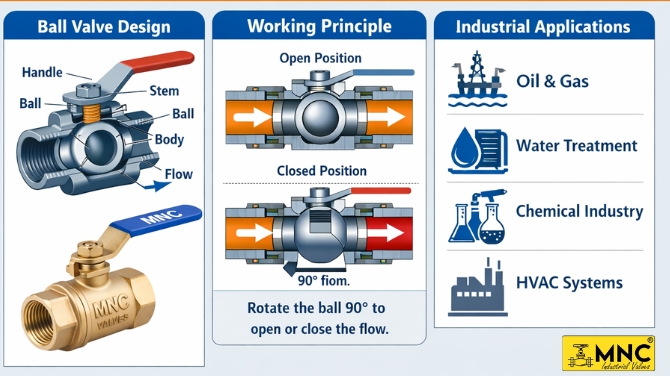
A ball valve is a quarter-turn rotary valve that uses a spherical closure element with a cylindrical bore to regulate fluid flow. The valve is in the open position when the bore and pipeline axis line up. When the ball is rotated 90 degrees, the solid part of the ball is positioned across the flow route, totally halting the flow.
Ball valves are mostly utilized for on/off service and provide rapid operation with minimal pressure drop. They are appropriate for essential isolation applications because of their capacity to provide tight shut-off even after extended use.
Design and Construction of a Ball Valve (Anatomy)
Valve Body and Body Construction Types
The primary component that maintains pressure and ensures structural integrity is the valve body. Typical body configurations consist of:
-
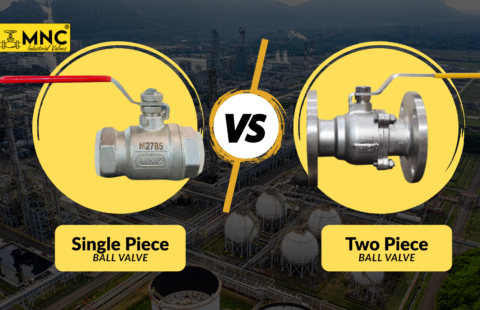
Single piece body: Compact, leak-resistant design, typically used for moderate pressure applications
-
Two-piece body: Allows internal access for maintenance while maintaining strength
-
Three-piece body: Enables complete disassembly and inline maintenance without removing the valve from the pipeline
Depending on installation standards, end connections can be butt welded, socket welded, screwed (threaded), or flanged.
Ball (Full Bore and Reduced Bore)
The ball contains a precision-machined bore that determines flow capacity.
-
Full bore ball valves allow unrestricted flow and are suitable for pigging and slurry service
-
Reduced bore ball valves reduce valve size and cost while maintaining isolation functionality
Seats and Sealing Mechanism
To create sealing, seats are placed on either side of the ball. Metal seats are utilized for abrasive or high-temperature services, although soft seats like PTFE and reinforced polymers are frequently used. Under certain working conditions, the sealing design guarantees bubble-tight shut-off.
Stem and Stem Sealing Arrangement
Rotational torque is transmitted by the stem, which joins the actuator to the ball. Industrial ball valves often have a blowout-proof stem construction. To stop exterior leaks, stem sealing is accomplished by O-rings, packing rings, or live-loaded packing devices.
Actuation Methods
Ball valves may be operated by:
-
Manual lever or gear operators
-
Pneumatic actuators for fast and automated operation
-
Electric actuators for remote and controlled applications
Working Principle of a Ball Valve
Rotational movement is the basis for a ball valve’s operation. The ball is rotated between open and closed positions by a quarter-turn movement of the stem. The ball entirely stops fluid flow when it is closed and seals against the seats.
By pushing the ball up against the downstream seat, line pressure helps the sealing mechanism and improves shut-off capability. Even in high pressure ball valve applications, this approach enables ball valves to achieve tight sealing.
Types of Industrial Ball Valves (Based on Design and Configuration)
Single Piece Ball Valves
Single Piece Flanged End Ball Valve
This valve’s one-piece body and flanged connections provide a compact design with fewer leak routes. It is frequently employed in industrial services with low to medium pressure.
Single Piece Screwed End Ball Valve
Compact installations, utility services, and pipes with modest diameters can all benefit from this arrangement, which has threaded ends.
Two Piece Ball Valves
Strong pressure containment and restricted maintenance access are provided by a two-piece body. When flanged connections are needed in industrial process pipelines, these valves are frequently utilized.
Three Piece Ball Valves
3 Piece Flanged End Ball Valve
Because of its design, the valve can be completely disassembled without affecting the pipeline. Applications that need regular upkeep or cleaning are better suited for it.
3 Piece Screwed End Ball Valve
Three-piece ball valves with threads are frequently utilized in small systems where removal and maintenance are crucial.
Multi-Way Ball Valves
3 Way Flanged End Ball Valve
This valve, which comes in L-port or T-port forms and is appropriate for intricate piping arrangements, is used for flow diversion or mixing.
3 Way Screwed End Ball Valve
Designed for threaded pipe systems, it offers the same flow control capabilities as flanged versions.
4 Way Flanged End Ball Valve
Allows multiple flow paths and directional control in advanced process systems, reducing the need for multiple valves.
4 Way Screwed End Ball Valve
Compact multi-port design used in low to medium pressure applications requiring directional flow control.
Trunnion Mounted Ball Valves
In this construction, trunnions at the top and bottom provide mechanical support for the ball. This lowers seat load and operating torque, which makes it appropriate for high pressure services and pipelines with large diameters. Refineries, high-pressure industrial systems, and oil and gas transmission all make extensive use of trunnion-mounted ball valves.
Materials of Construction
Industrial ball valves are manufactured using materials selected based on operating conditions:
-
Stainless Steel (SS 304, SS 316): Corrosion-resistant, suitable for chemical, pharmaceutical, and food processing industries
-
Carbon steel: is made to withstand high temperatures and pressures.
-
Cast Iron: Used in water, HVAC, and low-pressure systems
-
Brass: Suitable for utility and non-corrosive media
Material selection ensures structural integrity, corrosion resistance, and long service life.
Performance Characteristics
Key performance parameters include:
-
Pressure ratings from Class 150 to Class 2500
-
Temperature limits defined by body and seat materials
-
Bubble-tight shut-off performance
-
High cycle life with minimal wear
-
Low maintenance requirements
Industrial Applications of Ball Valves
Oil and gas, chemical and petrochemical, water and wastewater treatment, power generation, pharmaceutical and food processing, HVAC, and fire safety systems are just a few of the industries that heavily rely on ball valves.
Advantages of Ball Valves in Industrial Service
Quick quarter-turn action, low pressure drop, small size, dependable sealing, and extended operating life are among the technical benefits. Ball valves are appropriate for crucial isolation and control tasks because of their features.
Conclusion
An integral part of industrial flow control systems are ball valves. They provide flexibility for a variety of applications and are available in single piece, two piece, three piece, multi-way, and trunnion mounted versions. Ball valves continue to be an essential product for any ball valve manufacturer and supplier in India that serves international process industries, whether they are supplied as a stainless steel ball valve for hygienic services or a high pressure ball valve for harsh industrial settings.
Also Read:
Single Piece vs Two Piece Ball Valve – Industrial Buyer’s Guide