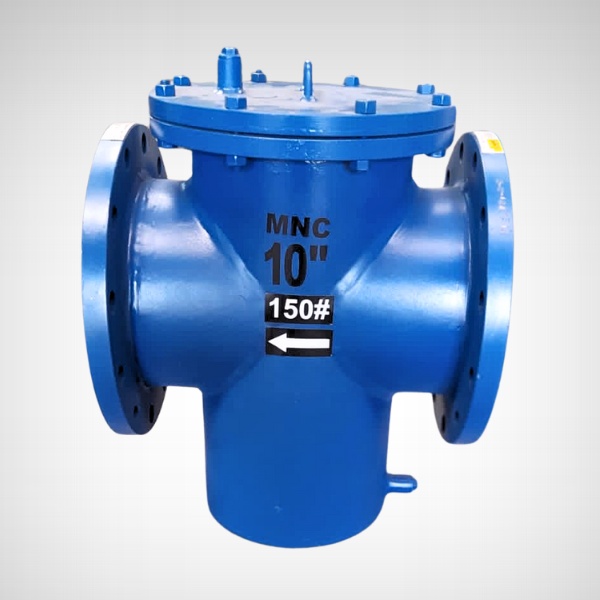
1. What is the primary function of a Basket Strainer?
+
A basket strainer removes solid contaminants from pipeline fluids to protect downstream
equipment such as pumps, valves, and heat exchangers.
2. How does a Basket Strainer differ from a Y Type Strainer?
+
Basket strainers have larger filtration capacity and are suitable for high-flow systems,
while Y strainers are compact and used in smaller pipelines.
3. What is the typical pressure drop across a clean Basket Strainer?
+
For clean baskets, the pressure drop is generally 0.03 to 0.15 bar, depending on flow rate and
mesh size.
4. What factors influence the pressure drop in a basket strainer?
+
Pressure drop depends on:
Flow velocity
Filtration mesh size
Basket surface area
Fluid viscosity
5. What is the recommended mesh size for industrial basket strainers?
+
Typical mesh sizes include:
40 mesh for coarse filtration
60 mesh for medium filtration
80–100 mesh for fine filtration
6. What materials are used for basket construction?
+
Baskets are typically manufactured from stainless steel SS304 or SS316.
7. What industries use basket strainers most frequently?
+
Basket strainers are widely used in oil & gas, petrochemical, power generation, water
treatment, and chemical industries.
8. What is the maximum size available for basket strainers?
+
Standard sizes are available up to DN 300, while sizes up to DN 600 can be manufactured
on request.
9. What pressure classes are available?
+
Basket strainers are commonly manufactured in Class 150 and Class 300.
10. How often should the basket be cleaned?
+
Cleaning frequency depends on contamination level in the pipeline and system operating
conditions.
11. What happens if the basket becomes clogged?
+
Clogging increases pressure drop and reduces system flow capacity.
12. Can basket strainers be used for steam systems?
+
Yes, basket strainers can be used in steam pipelines depending on material selection.
13. Are basket strainers suitable for corrosive fluids?
+
Yes, corrosion-resistant materials such as SS316 are used for corrosive media.
14. How is debris removed from basket strainers?
+
Debris is removed by opening the strainer cover and removing the basket for cleaning.
15. Can differential pressure gauges be installed with strainers?
+
Yes, differential pressure gauges help monitor screen clogging.
16. What is the advantage of large filtration area in basket strainers?
+
A larger filtration area reduces pressure drop and extends cleaning intervals.
17. What type of fluids can basket strainers handle?
+
They can handle water, oil, chemicals, hydrocarbons, and other industrial fluids.
18. Are drain connections available in basket strainers?
+
Yes, drain connections may be provided to remove debris without removing the basket.
19. Can custom filtration baskets be supplied?
+
Yes, custom perforation and mesh combinations can be provided.
20. How is the correct basket strainer selected?
+
Selection depends on pipeline size, pressure class, flow rate, filtration requirement, and
process media.