Swing Check Valve

Description

Industrial Swing Check Valve - MNC Valves

SWING CHECK VALVE

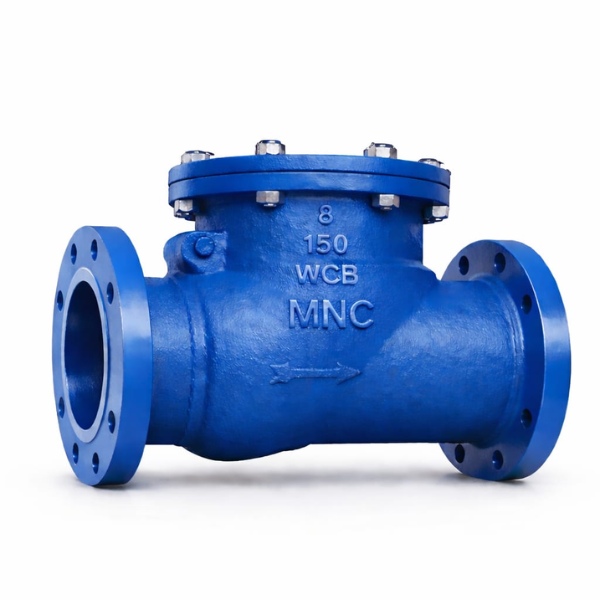
Industrial NRV Swing Check Valves | Flanged End | Class 150 / 300 / 600 | DN 15 – 600

MNC Industrial Valves is a trusted Swing Check Valve Manufacturer in India, manufacturing high-performance Non-Return Valves (NRV) designed to prevent reverse flow in industrial piping systems.

Swing check valves operate automatically using a hinged disc mechanism, allowing forward flow while preventing reverse flow when pipeline pressure drops or reverses.

These valves are widely used in oil & gas pipelines, petrochemical plants, power generation facilities, chemical processing plants, water treatment plants and industrial utilities where backflow protection is critical.

MNC Swing Check Valves are engineered for low pressure drop, reliable sealing, and long service life in demanding operating environments.

MANUFACTURING STANDARDS

Design Standard API 6D / BS 1868 / ASME B16.34
Face to Face Dimension ASME B16.10
Flanged End Connection ASME B16.5
Inspection & Testing API 598
Valve Marking MSS SP-25

PRODUCT OVERVIEW

  • Valve Type: Swing Check Valve
  • Function: Non Return / Backflow Prevention
  • Operation: Automatic Flow Operated
  • Design: Swing Disc
  • Installation: Horizontal Pipeline

Swing Check Valves are designed to automatically close when flow reverses, preventing damage to pumps and process equipment.

SIZE RANGE

Standard Manufacturing Range

DN 50 mm to DN 600 mm

PRESSURE CLASS

Available Pressure Ratings

  • Class 150
  • Class 300
  • Class 600

Pressure-temperature ratings as per ASME B16.34.

TEMPERATURE RANGE

Typical operating temperature range: –29Β°C to +425Β°C

Actual temperature limits depend on body material and gasket type.

MATERIAL OF CONSTRUCTION (MOC)

Component Body Material
Body Material ASTM A216 WCB, CF8 (SS304), CF8M (SS316)
Disc Material SS304, SS316 (Hard faced options available)
Seat Material Metal Seat (Optional soft seat for special services)
Hinge Pin SS410 / SS420
Bolting ASTM A193 B7, ASTM A194 2H
Gasket Graphite / PTFE

DESIGN FEATURES

  • Heavy duty cast body construction
  • Swing type disc mechanism
  • Low pressure drop across valve
  • Metal seat sealing design
  • Bolted bonnet construction
  • Long service life
  • Reliable backflow prevention
  • Suitable for high temperature service
  • Optional counterweight or lever arrangement

WORKING PRINCIPLE

Swing Check Valves operate using flow energy of the process fluid. During operation:

  • Forward flow pushes the disc open
  • Fluid passes through the valve with minimal restriction
  • When flow stops or reverses, gravity and reverse pressure close the disc automatically

This prevents reverse flow and protects upstream equipment.

INDUSTRIES

Swing Check Valves are widely used in:

  • Oil & Gas Industry
  • Petrochemical Plants / Refineries
  • Chemical / Power Generation Plants
  • Water Treatment / Steel / Cement Plants
  • Fertilizer / Marine / Pulp & Paper Industry

APPLICATIONS

Typical industrial applications include:

  • Pump discharge lines
  • Cooling water / Steam systems
  • Hydrocarbon / Chemical pipelines
  • Boiler feed water systems
  • Water supply / Fire protection systems

TESTING

All valves are tested as per API 598. Testing includes:

β€’ Hydrostatic Shell Test β€’ Seat Leakage Test β€’ Visual Inspection β€’ Pressure Retention Test

INSTALLATION GUIDELINES

  • Install in horizontal pipeline
  • Ensure correct flow direction marking
  • Provide adequate pipe support
  • Avoid installation in vertical flow downward pipelines
  • Ensure disc free movement during installation

ADVANTAGES OF SWING CHECK VALVES

βœ” Simple and reliable design
βœ” Low pressure drop
βœ” Automatic operation
βœ” Suitable for high temperature
βœ” Minimal maintenance
βœ” Long operational life

Frequently Asked Questions

1. What is the main function of a swing check valve? +
A swing check valve prevents reverse flow in pipelines by automatically closing when flow direction changes.
2. What is the difference between swing check and lift check valves? +
Swing check valves use a hinged disc mechanism, while lift check valves use a vertical moving disc guided by seat geometry.
3. Why are swing check valves preferred for large pipelines? +
They provide lower pressure drop compared to lift check valves, making them suitable for large diameter pipelines.
4. What is the typical cracking pressure of a swing check valve? +
Swing check valves generally have very low cracking pressure, typically less than 0.1 bar.
5. What factors influence valve closing speed? +
Closing speed depends on:
Flow velocity
Disc weight
Disc hinge friction
Pipeline orientation
Presence of counterweight
6. What causes water hammer in check valves? +
Water hammer occurs when flow reverses suddenly and the valve disc slams shut, creating pressure surge.
7. How can water hammer be minimized in swing check valves? +
It can be minimized by:
Installing dampers
Using spring assisted check valves
Optimizing pipeline design
8. What is the pressure drop across a swing check valve? +
Pressure drop is typically very low due to full bore flow path.
9. What are common failure modes of swing check valves? +
Common failure modes include:
Disc hinge wear
Seat erosion
Debris blockage
Improper installation
10. Why is a swing check valve installed after pumps? +
It prevents reverse flow that could cause pump damage or reverse rotation.
11. What standards govern swing check valve design? +
Common design standards include BS 1868, API 6D, and ASME B16.34.
12. What materials are commonly used for swing check valves? +
Typical materials include WCB carbon steel, stainless steel CF8, and CF8M.
13. What seat types are available? +
Seats may be metal seated or soft seated depending on service conditions.
14. Can swing check valves be used in vertical pipelines? +
They can be installed in vertical pipelines only when flow direction is upward.
15. What is the recommended installation orientation? +
Swing check valves are generally recommended for horizontal pipelines.
16. How does disc weight affect valve performance? +
Heavier discs may improve sealing but increase closing inertia.
17. What is the function of a hinge pin? +
The hinge pin supports the disc and allows pivoting movement during valve operation.
18. How is valve sizing determined? +
Valve size should match pipeline size and expected flow conditions.
19. What inspection standards apply to swing check valves? +
Inspection is generally conducted according to API 598 and project QAP requirements.
20. Can swing check valves be automated? +
No. Swing check valves operate automatically based on flow conditions and do not require external actuation.
ENQUIRY DETAILS REQUIRED

For correct selection please provide:

  • Pipeline Size (DN / Inch)
  • Pressure Class
  • Body Material
  • Process Media
  • Operating Temperature
  • End Connection Type
  • Quantity
  • Application Details

Our engineering team will assist in selecting the correct Swing Check Valve.