
MNC Valves Ltd.
MNC Valves Limited manufactures double offset butterfly valves engineered for reduced seat friction, improved sealing performance, lower operating torque, and longer service life in demanding industrial, utility, chemical, process, and high-performance pipeline applications.
High-performance double offset design
Reduced seat wear and lower friction during operation
Suitable for more demanding pressure and temperature conditions
Available in gear, pneumatic, and electric operated configurations
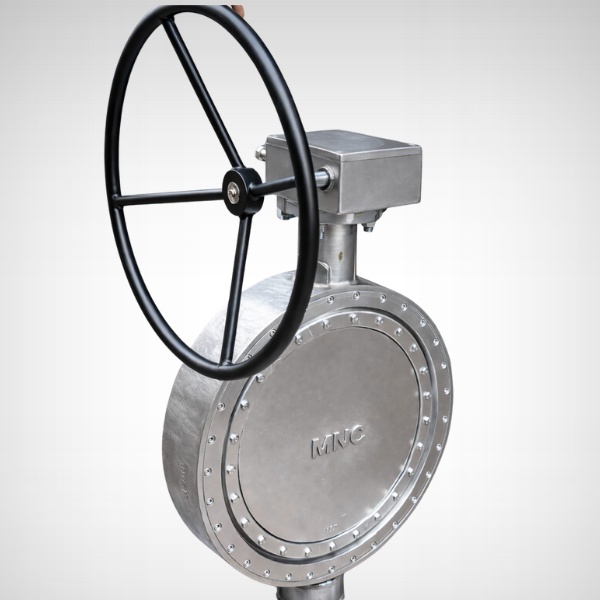
MNC Valves Limited offers double offset butterfly valves for applications where standard resilient seated butterfly valves may not be sufficient. Double offset geometry is used to reduce seat rubbing during operation, improve sealing performance, and support longer valve life in more demanding service conditions.
These valves are commonly used in higher performance water systems, process industries, chemical service, power support lines, utility networks, and selected high-temperature or frequent-cycling applications where improved operating characteristics are required.
A double offset butterfly valve is a high-performance butterfly valve in which the shaft is offset from the valve centerline and sealing plane. This geometry allows the disc to disengage from the seat more quickly during opening, reducing friction, lowering wear, and improving shut-off performance compared with standard concentric designs.
This design is commonly selected where the buyer requires better sealing reliability, longer service life, and more stable performance under tougher operating conditions.
The shaft is positioned with two offsets relative to the disc and sealing plane, allowing reduced contact between disc and seat during operation.
The disc movement minimizes seat rubbing, which helps reduce wear and improve valve life in repetitive operating cycles.
Double offset design supports improved sealing behavior compared with standard concentric butterfly valve designs in many conditions.
Details
Double Offset Butterfly Valve
DN 50 to DN 1200
PN10 / PN16 / PN25 / PN40 / Class 150 depending on design
DI / WCB / CF8 / CF8M
SS304 / SS316 / SG Iron with suitable facing as required
EPDM / NBR / PTFE / Metal depending on application
SS410 / SS304 / SS316
Wafer / Lug / Double Flanged depending on design
Gear / Pneumatic / Electric
API / BS / EN as applicable
API 598
Suitability
Excellent
Highly suitable
Highly suitable
Concentric may be more economical
Wafer type may be more suitable
Very suitable with PTFE or metal seat selection
Suitable in selected chemical service with PTFE seated or stainless construction depending on media compatibility.
Used where a higher-performance butterfly valve is preferred over standard resilient seated designs.
Useful in selected utility and service lines where improved valve life and sealing reliability are required.
Applicable in more demanding service conditions requiring lower friction and improved reliability.
Suitable where repeated opening and closing cycles would create excessive wear in standard designs.
Useful where improved sealing, smoother operation, and lower wear are important decision factors.
Sealing Design
Offset high-performance geometry
Centered resilient seated design
Seat Friction
Lower
Higher
Performance Level
Higher
Standard
Cost
Higher
More economical
Best Use
Demanding and high-performance applications
General water and utility service
Contact MNC Valves Limited for technical guidance, product selection support, and quotation for your industrial requirement.=
Technical support for selection
Quotation support for project needs
Application-focused product guidance
Business-ready follow-up action
MNC Valve Limited Popular Products
Ball Valve
Butterfly Valve & Gate Valve
Strainers Valve
Non Return Valve
Control Valve
Other Valve
It is a high-performance butterfly valve with offset shaft and sealing geometry designed to reduce seat friction and improve performance.
It is used in higher-performance water, process, chemical, utility, and industrial service applications.
Because it reduces seat rubbing, lowers wear, and improves sealing reliability during operation.
Yes, depending on design and service requirement, rubber, PTFE, or metal seat arrangements may be used.
Yes, with proper material and seat selection, it can be highly suitable for selected chemical applications.
Reduced seat friction lowers wear, extends valve life, and supports smoother operation.
Yes, pneumatic and electric actuation are commonly used with this valve type.
EPDM, NBR, PTFE, and metal seats are commonly selected depending on service condition.
Yes, it is often preferred in frequent operation duty because reduced friction lowers wear.
DI, WCB, CF8, and CF8M are commonly available depending on requirement.
Common causes include incorrect seat selection, damaged disc or seat, or unsuitable installation and service condition.
No. Double offset uses a different shaft and sealing geometry for higher performance and reduced wear.
Yes, in many cases it is a higher-cost but higher-performance option.
Because these valves are often used in larger sizes or more demanding applications where more controlled operation is needed.
No. It is best for higher-performance duty, while concentric valves may be more economical for standard utility service.
WhatsApp us