
MNC Valves Limited offers high-performance Disc Check Valves designed for compact installation, automatic reverse flow prevention, and efficient one-way flow control in industrial piping systems. Disc Check Valves are widely used in water treatment, utility systems, process piping, HVAC lines, compact skids, and industrial applications where reduced size, simple construction, and dependable non-return function are important.
Compact disc-based non-return design for industrial service
Automatic reverse flow prevention in space-conscious systems
Suitable for water, utilities, process fluids, and general industrial duty
Suitable for domestic and export-oriented industrial projects
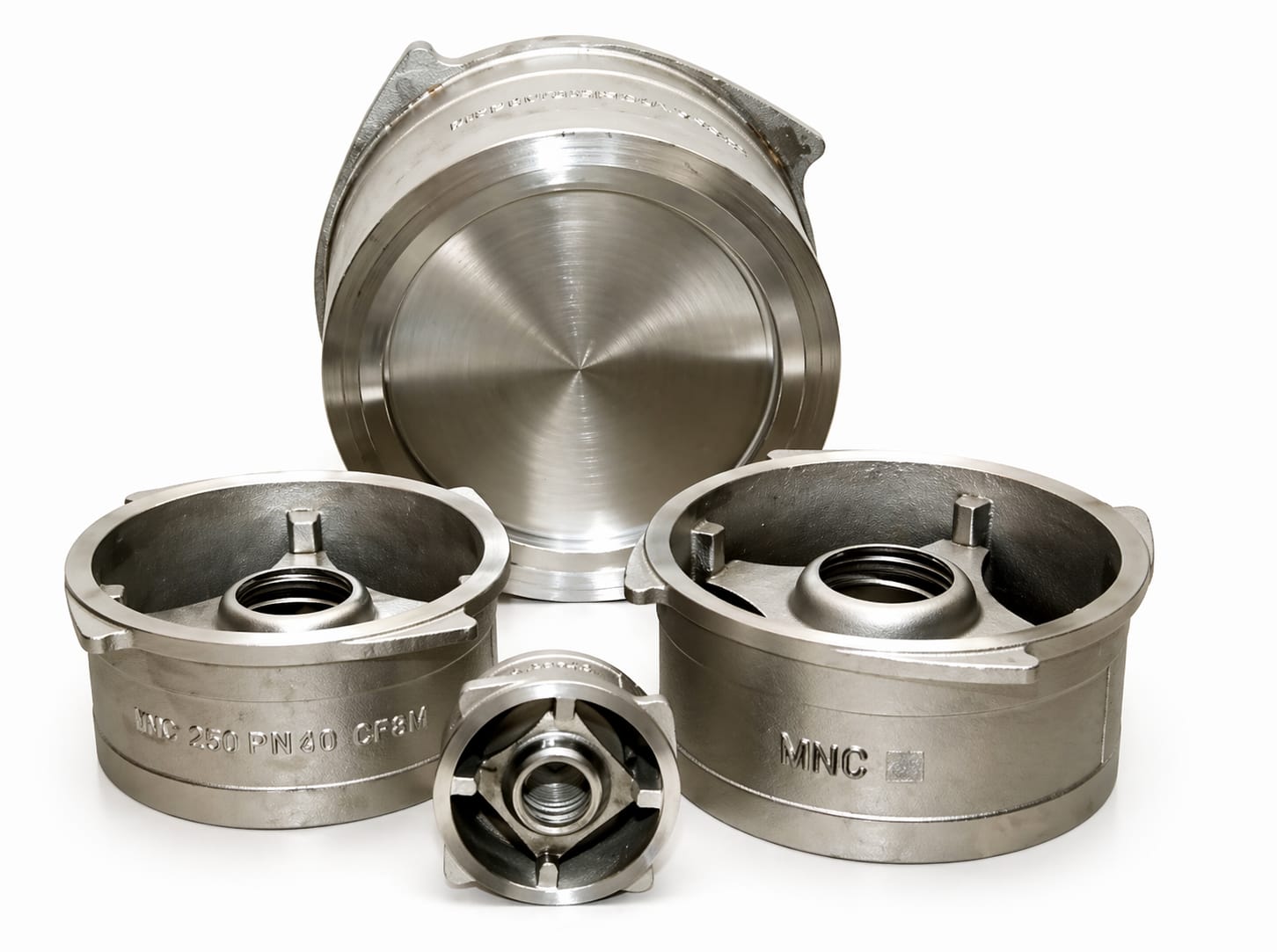
A Disc Check Valve is a compact non return valve that uses a disc-type closure element to allow forward flow and automatically prevent reverse flow. When the forward flow pressure is sufficient, the disc moves away from the seat and allows fluid to pass. When the flow reduces or reverses, the disc returns to the seat and closes the valve automatically.
Disc Check Valves are widely selected where compact size, simple internal movement, and automatic one-way flow protection are required. They are suitable for many general industrial, water, utility, and process applications where space-saving design and reliable reverse flow prevention are important
Many piping systems require automatic non-return protection but do not always have space for larger conventional check valve designs. A Disc Check Valve offers a compact alternative that helps control reverse flow while supporting efficient installation in tight or space-sensitive systems.
Useful where pipeline layout requires reduced valve size and installation space.
Stops backflow automatically and helps maintain one-way process flow.
Disc movement offers dependable non-return operation in many general applications.
Under forward flow pressure, the internal disc moves away from the seat and allows fluid to pass through the valve body.
When flow stops or reverses, the disc returns to the seat and closes automatically, preventing reverse flow in the pipeline.
Useful where installation space is restricted and compact valve design is preferred.
Provides dependable reverse flow prevention without manual operation.
Applicable in water, utility, and process systems requiring compact one-way flow protection.
Used in selected compact process lines, utility piping, and water systems requiring non-return protection.
Suitable for automatic backflow prevention in industrial utility systems.
Applicable in compact line systems where one-way flow control is important.
Preferred in certain skid systems where valve size and installation space must be minimized.
Useful in industrial piping arrangements where a compact check valve is preferred.
Selected where reverse flow control is required in compact utility or support piping.
Disc Check Valve
Automatic reverse flow prevention / one-way flow control
Disc opening on forward flow and closing on reverse flow
Compact body design
WCB / CF8 / CF8M / application-specific construction
SS / corrosion-resistant / application-based material selection
Application-specific compact connection design
As per design suitability and project requirements
Water / utility fluids / process fluids / industrial media
Compact utility systems / process skids / general industrial piping
Main Emphasis
Disc-based compact non-return function
Wafer-style compact mounting between flanges
Commercial Positioning
Often selected as a compact disc mechanism type
Often selected by body style and installation format
Installation Logic
Depends on design and application
Typically focused on wafer mounting arrangement
Typical Preference
Compact disc-based check valve requirement
Compact flange-to-flange installation requirement
Selection Basis
Internal mechanism and service need
Body style and installation format
In industrial practice, the term Disc Check Valve is often used to describe a compact check valve built around a disc-type closure element. Depending on manufacturer design and commercial naming, Disc Check Valve and Wafer Check Valve may overlap in certain markets, but for product positioning and buyer search logic they are often treated as separate categories.
Suitable for EPCs and consultants requiring compact non-return solutions for engineered systems.
Useful where compact valve profile and simplified installation logic support skid packaging.
For export and industrial projects, Disc Check Valves can be reviewed against applicable customer specifications, pressure class requirements, connection standards, line class requirements, and relevant international standards such as API, ASME, and EN requirements where applicable to the project scope.
Contact MNC Valves Limited for application-based support, compact valve selection guidance, and quotation for your Disc Check Valve requirement.
Compact design support
Disc mechanism support
Utility service support
Project quotation support
MNC Valve Limited Popular Products
Ball Valve
Butterfly Valve & Gate Valve
Strainers Valve
Non Return Valve
Control Valve
Other Valve
A Disc Check Valve is a compact non return valve that uses a disc-type closure element to allow forward flow and prevent reverse flow automatically.
It is often chosen for compact size, simple disc-based construction, and automatic reverse flow protection in space-conscious systems.
It is commonly used in water treatment, utilities, HVAC systems, industrial skids, and general process pipelines.
The main advantage is compact installation with automatic non-return functionality.
Yes, it can be used in certain pump-related systems where automatic reverse flow prevention is required.
No. It operates automatically according to the flow condition in the pipeline.
Yes, provided body and trim materials are selected according to the actual chemical media and service conditions.
Disc Check Valve refers more to the disc-based closure mechanism, while Wafer Check Valve refers more to the compact wafer-style body installation format.
Common materials include WCB, CF8, CF8M, and other application-specific materials depending on service conditions.
Cracking pressure is the minimum forward pressure required to open the disc and allow fluid to flow through the valve.
Yes, pressure drop exists and should be checked based on valve size, design, and actual operating flow.
Yes, they can be designed for higher pressure services depending on construction and project requirements.
Incorrect installation can affect valve operation and may result in improper closure, vibration, or reduced performance.
It can be used in certain vertical installations depending on valve design and application conditions, but project review is important.
They are generally more suitable for clean or moderately clean service. Application review is needed for dirty media conditions.
Compact design helps improve installation flexibility, reduce required space, and support skid-based or tight pipeline layouts.
Industries include water treatment, utilities, HVAC, industrial skids, and general process plants.
The valve size should match the pipeline size, but final selection should also consider pressure conditions, flow rate, and project design.
Because they offer automatic reverse flow prevention without requiring the larger space of conventional check valve bodies.
MNC Valves Limited provides application-based support, project-oriented guidance, and compact export-compatible valve solutions.
WhatsApp us