
MNC Valves Ltd.
25+ Years Experience in industrial valve manufacturing and supply
Size range available from DN15 to DN200
Available in L Port and T Port configurations
Preferred for mixing, diverting, and distribution flow applications
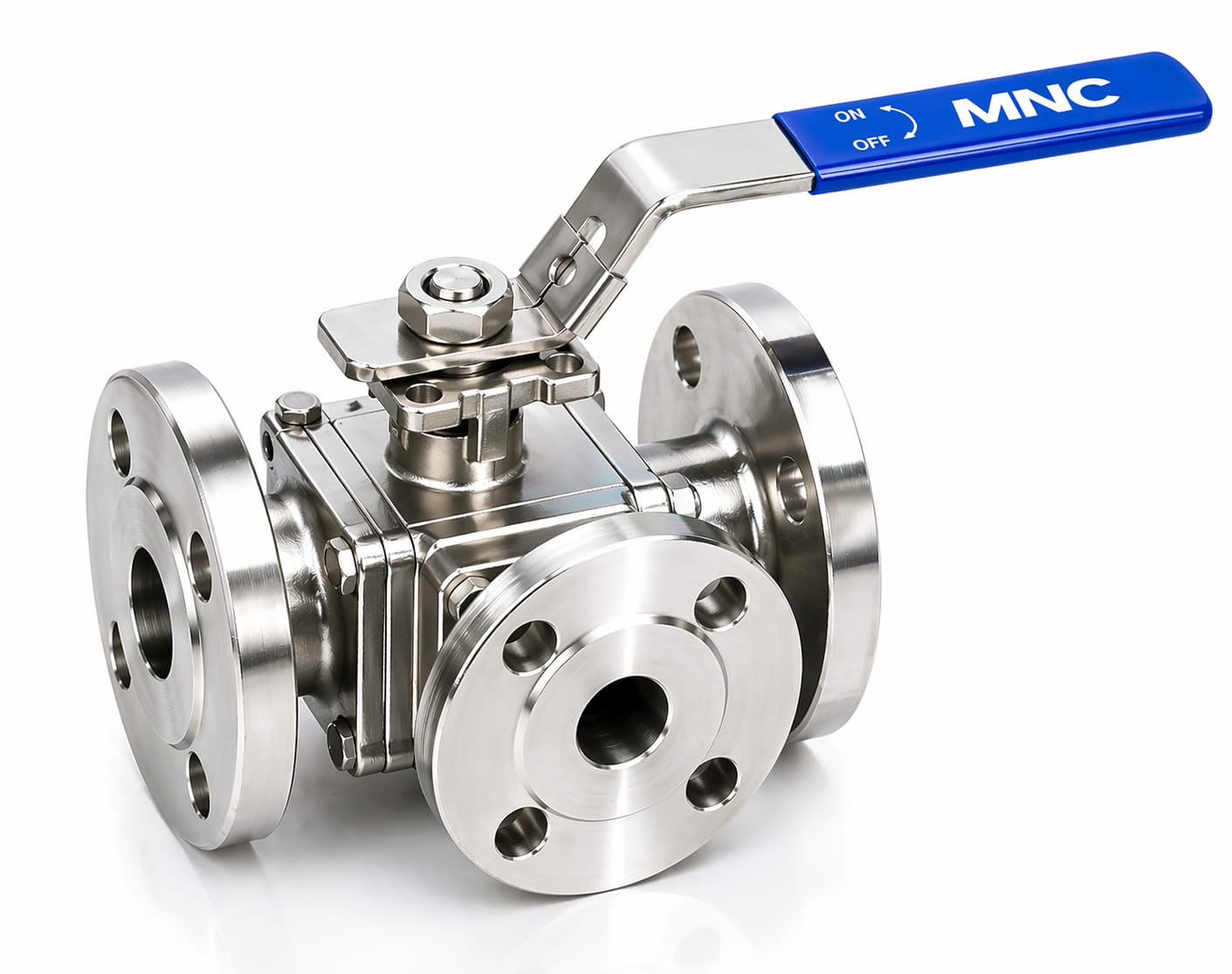
MNC VALVES LIMITED is a trusted manufacturer and supplier of 3 Way Flanged End Ball Valves engineered for multi-directional flow control where conventional 2-way valves are not sufficient. These valves are widely selected in process systems requiring flow diversion, flow switching, or mixing through a compact and reliable valve arrangement.
The 3 way flanged design combines the strength of flanged end installation with the flexibility of multi-port flow control. It helps reduce piping complexity, eliminate additional valves, and improve system layout efficiency in industrial applications.
A 3 Way Flanged End Ball Valve is a quarter-turn ball valve with three flow ports and flanged end connections. It is designed to direct flow between multiple passages using a specially machined ball port configuration. Depending on the ball type and orientation, the valve can divert, mix, isolate, or distribute media in different directions.
This valve category is commonly selected where the buyer needs compact multi-line control, reduced piping complexity, dependable shut-off, and operational flexibility in industrial process systems.
Specially machined internal ball port geometry allows controlled flow switching and mixing functions.
Provides strong and secure industrial pipeline connection for fixed process systems.
Allows fast and reliable switching between different flow paths using a compact operating mechanism.
L Port design is mainly used for diverting service. It allows one inlet flow to be directed to one of two outlet paths depending on valve position.
T Port design is used for mixing, distribution, or combined flow paths. Depending on orientation, it can allow multiple passage connectivity.
Details
3 Way Ball Valve
Flanged EndFlanged End
150# / 300#
L Port / T Port
Full Bore / Reduced Bore
ASME B16.34 / Applicable industrial standard
ASME B16.10 / As applicable
ASME B16.5
API 598
Lever / Pneumatic / Electric
WCB / CF8 / CF8M
PTFE / RPTFE
3 way flanged ball valves are commonly selected in Class 150 and 300 pressure ratings depending on design and application requirement. Final suitability depends on valve size, media, and operating conditions.
Temperature capability depends on seat and body material selection. PTFE and RPTFE seats are suitable for many industrial media, while the exact limit should be matched with service conditions.
Helps reduce the need for multiple valves and fittings in multi-directional flow systems.
Supports diverting, switching, and mixing applications in one compact valve arrangement.
Flanged ends provide secure connection in fixed process and utility pipeline systems.
Suitable for flow diverting and media routing in chemical systems.
Suitable in process support systems where multi-directional flow control is needed.
Used where line switching or utility routing is required in treatment systems.
Useful in routing and switching duty for treatment and process utilities.
Selected where compact flow control logic and material compatibility are important.
Widely used where one valve must control multiple flow directions efficiently.
Flow Direction
Multi-directional
Single flow path
Main Use
Mixing / diverting / switching
Open-close isolation
Piping Complexity
Reduced
Higher if multiple directions are needed
Application Flexibility
Higher
Lower for multi-line systems
Industrial product understanding built through long market and application exposure.
Technical guidance for selecting the correct port design and valve configuration.
Structured manufacturing and testing approach for dependable flow control performance.
Connect with MNC VALVES LIMITED for technical support, port selection guidance, and quotation for your industrial requirement.
Technical support for selection
Quotation support for project needs
Application-focused product guidance
Business-ready follow-up action
It is a multi-port quarter-turn valve used for mixing, diverting, and switching flow between multiple directions.
The size range for flanged end 3 way ball valves is DN15 to DN200.
L Port is mainly used for diverting service, while T Port is mainly used for mixing or distribution service.
These valves are commonly available in 150# and 300# classes depending on design and application.
A 3 way valve helps reduce piping complexity where multiple flow paths must be controlled through one valve.
Yes, T Port configuration is commonly used for mixing and combining flow paths.
Yes, L Port configuration is commonly used for diverting one flow into alternate directions.
WCB, CF8, and CF8M are commonly used depending on service media and corrosion conditions.
PTFE and RPTFE are commonly used depending on temperature and service conditions.
Yes, with suitable stainless steel body and compatible seat material selection.
It is mainly selected for flow path switching, mixing, and diverting rather than precision throttling duty.
ASME B16.34, ASME B16.10, ASME B16.5, and API 598 are commonly referenced depending on design.
Yes, manual, pneumatic, and electric operated versions can be provided depending on requirement.
Chemical, water treatment, oil & gas utility, textile, pharma, and general process industries commonly use it.
Flanged ends provide stronger industrial pipeline connection and are suitable for fixed process systems.
The choice depends on whether the application needs diverting duty or mixing/distribution duty.
Periodic inspection of seats, ball surface, stem sealing, and operating smoothness is recommended.
Yes, it can reduce the need for multiple 2-way valves and fittings in multi-directional flow systems.
Valve size, pressure, seat material, media condition, and port geometry affect the torque requirement.
Because MNC VALVES LIMITED offers application-based port selection support, reliable manufacturing quality, and practical technical guidance.
WhatsApp us