
Industrial valve engineering guide for thermal power, steam, boiler, turbine, and utility applications. MNC Valves Limited supports power generation systems with industrial valve solutions designed for high-pressure, high-temperature, continuous-duty, and severe-service applications.
Power plants operate under demanding industrial conditions involving steam handling, thermal cycling, pressure fluctuation, condensate systems, cooling water circulation, feedwater systems, and operational safety requirements.
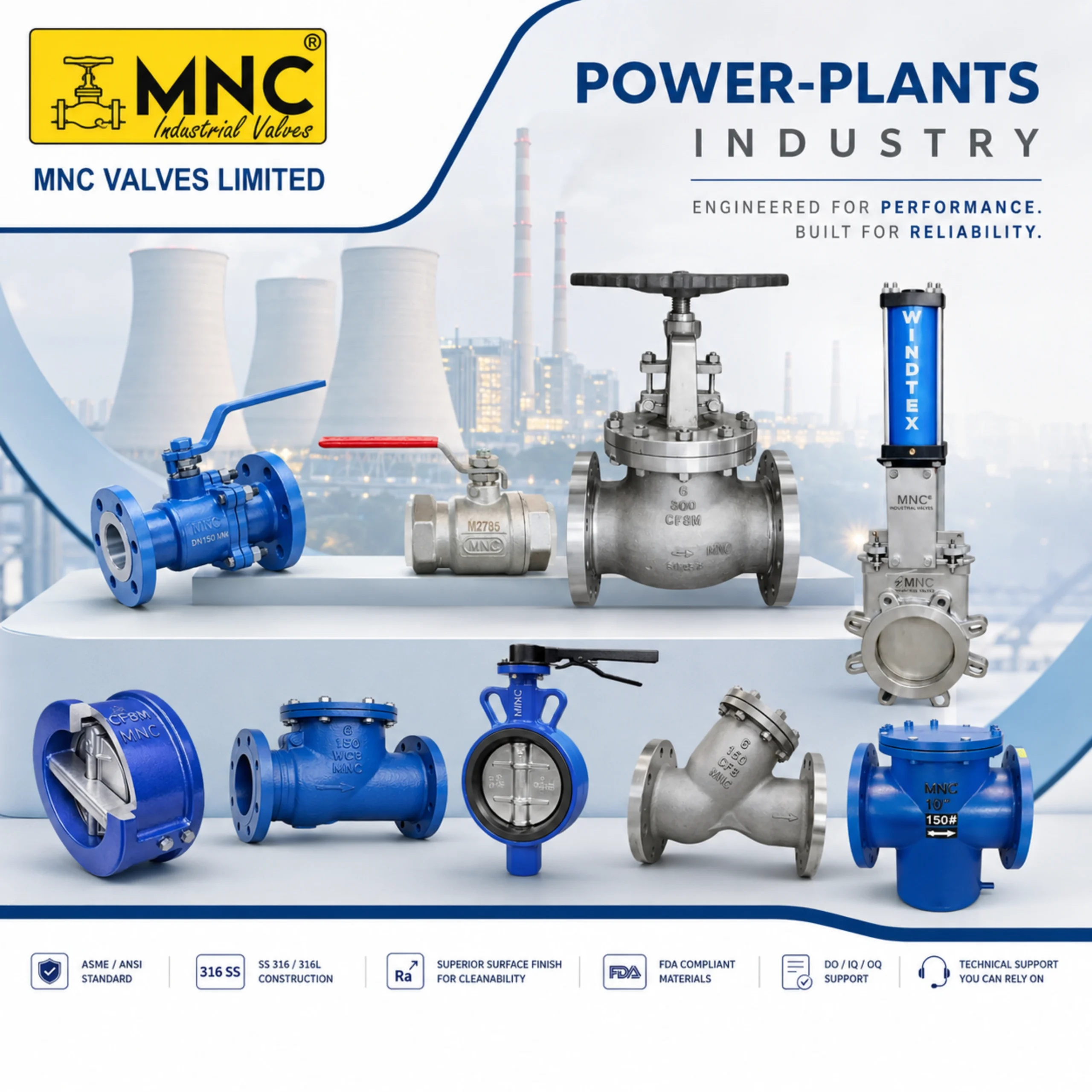
Power plants operate under some of the most demanding industrial conditions involving high pressure, high temperature, continuous-duty operation, thermal cycling, steam handling, condensate recovery, cooling water circulation, fuel systems, feedwater control, and critical process safety requirements.
Industrial valves used in power generation systems directly influence plant safety, steam control, operational stability, turbine protection, pressure integrity, leakage prevention, thermal efficiency, equipment protection, maintenance reliability, process isolation, emergency shutdown capability, and energy efficiency.
For this reason, valve selection in power plant applications must be based on operating pressure, operating temperature, steam compatibility, thermal stability, pressure-temperature rating, erosion resistance, sealing reliability, automation requirement, continuous-duty suitability, and operational safety.
Power plants involve severe operating conditions that require robust industrial valve performance and reliable operational stability under continuous-duty service conditions.
Steam systems operate under demanding pressure conditions requiring pressure integrity and thermal stability.
Repeated heating and cooling cycles can affect sealing reliability and material stability.
High-velocity steam may cause erosion damage in unsuitable valve materials or trim configurations.
Pressure drop conditions may create cavitation risk in control and regulation applications.
Power systems often involve varying pressure conditions requiring reliable valve performance.
Power plants operate continuously and require dependable long-term valve reliability.
Boiler systems operate under high-pressure and high-temperature conditions where steam generation and feedwater circulation are critical.
Boiler applications require robust body construction, suitable trim materials, reliable shut-off capability, and long-term continuous-duty reliability.
Steam turbine systems require accurate steam handling and reliable process control to maintain turbine efficiency and operational stability.
Main steam systems require pressure integrity, thermal reliability, and controlled steam handling.
Isolation valves support operational safety, maintenance shutdown, and emergency protection.
Control valves support steam regulation, turbine stability, and operational efficiency.
Feedwater systems supply treated water into boilers under controlled pressure and temperature conditions. These systems are critical for boiler protection, steam generation stability, and continuous-duty power plant operation.
Feedwater control valves are critical for boiler protection and process stability. Valve selection must consider pressure control, erosion resistance, temperature compatibility, operational safety, pump protection, and pressure integrity.
Cooling water systems circulate large volumes of water through condensers, cooling towers, heat exchangers, and auxiliary equipment. These systems generally require large diameter valves with low pressure drop and dependable shut-off performance.
Butterfly valves are commonly preferred for large cooling water pipelines due to lightweight construction, economical installation, easy operation, and suitability for large diameter service.
Condensate systems recover steam condensate and return it back into the feedwater cycle. Reliable condensate handling improves thermal efficiency, reduces water loss, and supports overall process stability.
Condensate systems require corrosion resistance, low leakage, pressure stability, and reliable operational performance.
Power plants may use coal, gas, oil, biomass, or other fuels depending on plant type. Fuel handling systems require dependable shut-off capability, leakage prevention, pressure compatibility, and operational safety.
Fuel systems require reliable isolation performance, fire-safe considerations, leakage prevention, and operational reliability according to the project and process requirement.
Correct valve selection depends on process condition, pressure, temperature, valve function, severe service exposure, and operational criticality. Valve selection should not be based only on size or general availability.
| Function | Common Valve Type |
|---|---|
| Isolation | Gate Valve / Ball Valve |
| Steam Regulation | Globe Valve / Control Valve |
| Cooling Water | Butterfly Valve |
| Backflow Prevention | Check Valve |
| Fuel Isolation | Ball Valve |
| Severe Service Regulation | Control Valve |
Different power plant systems require different valve technologies depending on service conditions, pressure, temperature, media, valve function, and operational criticality.
| Valve Type | Typical Application | Key Advantages | Limitations |
|---|---|---|---|
| Gate Valve | Steam & isolation systems | Full bore flow & reliable shut-off | Slower operation |
| Globe Valve | Steam regulation | Accurate throttling capability | Higher pressure drop |
| Butterfly Valve | Cooling water systems | Lightweight & economical | Limited severe-service suitability |
| Ball Valve | Fuel & utility systems | Tight sealing & fast operation | Not ideal for severe throttling |
| Check Valve | Pump protection | Prevents reverse flow | No flow regulation |
| Control Valve | Pressure & flow control | Accurate automated regulation | Higher engineering complexity |
Material selection is critical due to high-pressure, high-temperature, steam velocity, erosion risk, thermal cycling, pressure fluctuation, and continuous-duty operating conditions.
| Material | Typical Application |
|---|---|
| WCB | General power plant service |
| WC6 / WC9 | High-temperature steam service |
| Alloy Steel | Severe service applications |
| Chrome Moly Steel | High-pressure steam systems |
| CF8 / CF8M | Corrosion-resistant systems |
| Stainless Steel | Condensate & chemical systems |
| Forged Steel | High-pressure applications |
Material suitability must consider pressure, temperature, steam velocity, erosion risk, thermal cycling, and project specifications.
Power plant valves may require compliance with international engineering standards according to process criticality, safety requirements, pressure-temperature ratings, and project specifications.
| Standard | Description |
|---|---|
| API 600 | Gate Valve Design |
| API 602 | Forged Steel Valve Design |
| API 598 | Valve Testing |
| ASME B16.34 | Pressure Temperature Rating |
| ASME Standards | Steam & Power Piping Systems |
| ISO 5208 | Valve Pressure Testing |
Compliance with standards supports pressure integrity, operational safety, steam compatibility, severe service suitability, and long-term reliability.
Modern power plants increasingly use automated valves for process control, operational stability, emergency isolation, remote operation capability, and continuous-duty reliability.
Used where fast operation, repeated cycling, and process automation are required.
Used where remote operation, panel integration, and controlled movement are required.
Used where high thrust, critical control, or severe service actuation is required.
Incorrect valve selection in power plants can lead to leakage, erosion, pressure instability, thermal damage, equipment risk, process interruption, and maintenance shutdowns.
Valve pressure class must match actual operating conditions and pressure fluctuation levels.
High-temperature service requires suitable body, trim, and seat material selection.
Gate valves should not be used where accurate throttling and steam control are required.
Steam and high-velocity service can damage unsuitable valve materials.
Continuous heating and cooling cycles may affect valve integrity and sealing reliability.
Improper material selection may lead to leakage, erosion, thermal damage, or early failure.
Power plant systems use different valve technologies according to service type, pressure-temperature condition, media, and operational criticality.
| Application | Common Valve Type |
|---|---|
| Boiler Isolation | Gate Valve |
| Steam Regulation | Globe Valve / Control Valve |
| Cooling Water Systems | Butterfly Valve |
| Feedwater Control | Globe Valve / Control Valve |
| Condensate Systems | Ball Valve / Check Valve |
| Fuel Systems | Ball Valve |
| Pump Protection | Check Valve |
| Severe Service Steam Lines | Forged Steel Valve |
MNC Valves Limited supports power generation systems with industrial valve solutions designed for high-pressure, high-temperature, severe-service, steam, condensate, cooling water, and utility applications.
Valve selection is reviewed according to operating pressure, temperature, and service conditions.
Applications involving steam, thermal cycling, erosion, and pressure fluctuation require proper engineering awareness.
Material and valve type selection are aligned with steam service and power plant process needs.
Pneumatic, electric, hydraulic, and control valve options support automated power plant operation.
Valve recommendations consider continuous operation, process stability, and maintenance reliability.
Selection is based on actual operating conditions, application criticality, and project requirements.
If you require industrial valves for power plant applications, MNC Valves Limited can assist in selecting valve type, pressure class, body material, trim material, seat material, automation option, severe service suitability, steam compatibility, and cooling water suitability.
Please share your BOQ, P&ID, operating pressure, operating temperature, media details, automation requirement, and project specifications for technical guidance and quotation support.
Valve recommendations on this page are provided as general engineering guidance for power generation and utility applications.
Final valve selection should always be verified according to process conditions, operating pressure, operating temperature, media characteristics, engineering specifications, customer standards, safety requirements, and severe service conditions.
Correct engineering evaluation is essential for reliable and safe power plant operation.