
Industrial valve engineering guide for upstream, midstream, downstream, and hydrocarbon applications. MNC Valves Limited supports oil & gas systems with valve solutions designed for pressure containment, hydrocarbon isolation, severe-service reliability, and operational safety.
Oil & gas systems involve high-pressure hydrocarbons, flammable media, thermal cycling, pressure fluctuation, emergency shutdown requirements, and continuous-duty process operation.
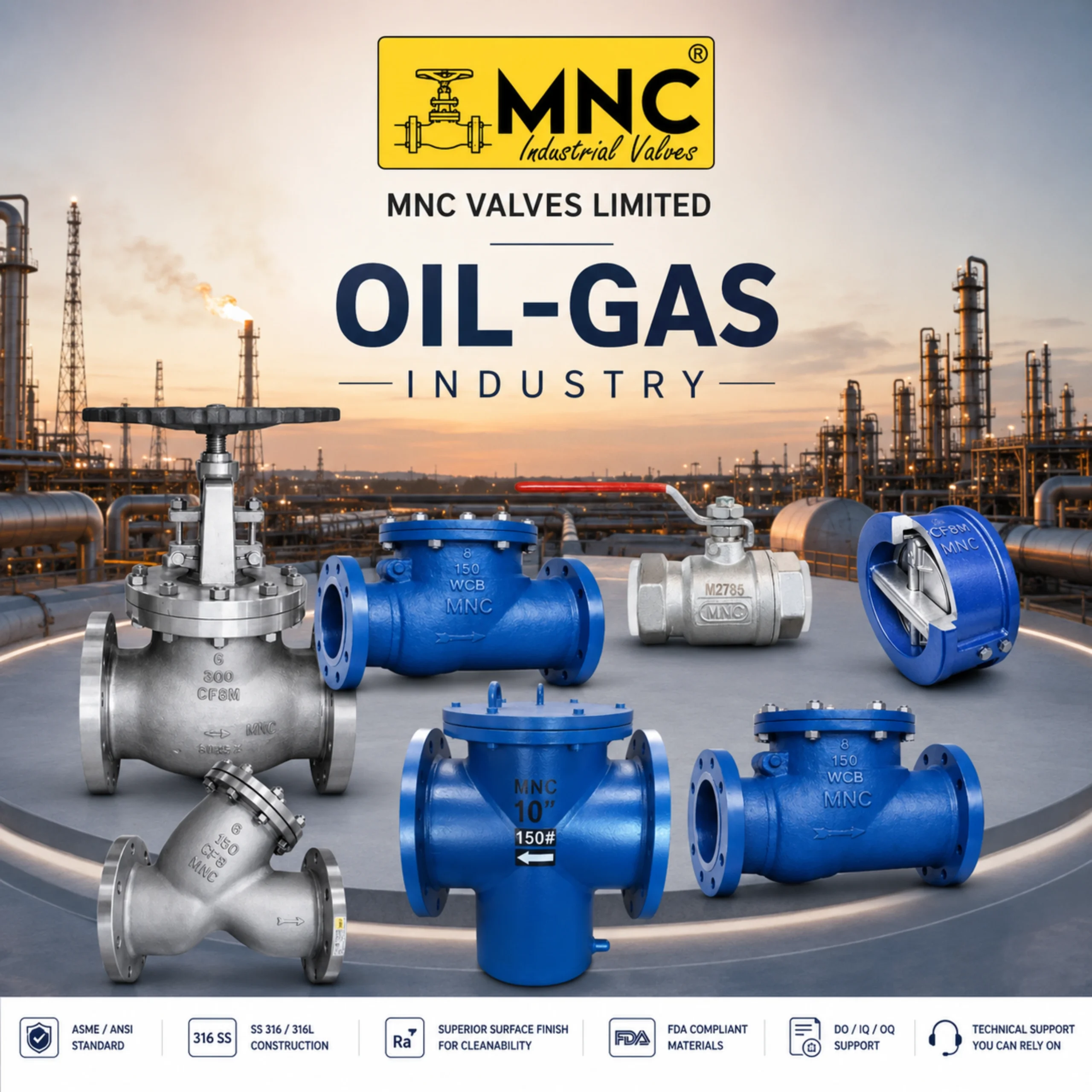
Oil & gas industries operate under some of the most demanding industrial conditions involving high-pressure hydrocarbons, flammable media, severe-service operation, emergency shutdown requirements, pressure fluctuation, thermal cycling, and continuous-duty process systems.
Industrial valves used in oil & gas applications directly influence operational safety, hydrocarbon isolation, pressure containment, leakage prevention, emergency shutdown reliability, process stability, pipeline safety, refinery operation, equipment protection, environmental safety, maintenance reliability, and continuous-duty operation.
For this reason, valve selection in oil & gas applications must be based on pressure class, hydrocarbon compatibility, shut-off integrity, fire-safe consideration, severe-service suitability, pressure-temperature rating, fugitive emission awareness, automation requirement, corrosion resistance, and operational safety.
Oil & gas industries involve multiple process areas where industrial valves perform isolation, pressure regulation, hydrocarbon handling, emergency shutdown, pipeline control, equipment protection, and process safety functions.
Exploration, drilling, wellhead systems, production systems, separator systems, and crude extraction processes.
Transmission pipelines, compressor stations, LNG transfer systems, tank farms, and loading terminals.
Refinery process units, hydrocarbon transfer, tank farm isolation, utility systems, and process control systems.
Process chemical handling, hydrocarbon derivatives, utility services, and process isolation applications.
Gas handling, LNG transfer, high-pressure gas systems, and terminal process applications.
Severe-service systems requiring operational safety, pressure containment, and shutdown reliability.
Upstream systems involve exploration, drilling, wellhead systems, production systems, and crude extraction processes. These applications may involve high-pressure hydrocarbons and continuous-duty operating conditions requiring robust valve construction.
Midstream systems transport crude oil, gas, LNG, and hydrocarbons through long-distance transmission pipelines and terminal systems. Pipeline systems require dependable shut-off performance and operational reliability under continuous-duty conditions.
Downstream systems involve refineries, petrochemical plants, hydrocarbon processing units, utility systems, and storage facilities. Refinery systems require reliable valve performance under demanding process conditions.
Oil & gas industries involve severe operating conditions requiring reliable industrial valve performance, dependable shut-off integrity, pressure containment capability, and operational safety under continuous-duty process conditions.
Hydrocarbon systems often operate under demanding pressure conditions requiring reliable sealing and pressure integrity.
Oil & gas applications involve flammable and hazardous media requiring higher safety awareness.
Repeated heating and cooling cycles may affect sealing performance and material stability.
Pipeline and refinery systems may experience changing pressure conditions during operation.
Pressure drop conditions may create cavitation and flashing risk in control applications.
Oil & gas systems often operate continuously and require dependable long-term valve reliability.
Hydrocarbon systems require dependable isolation performance, leakage prevention, operational safety, emergency shutdown capability, and reliable shut-off integrity.
Oil & gas applications demand reliable valve performance to support plant and personnel safety.
Valve pressure integrity is critical for high-pressure hydrocarbon service.
Critical systems may require rapid hydrocarbon isolation during emergency conditions.
Hydrocarbon systems require dependable sealing performance and low leakage operation.
Flammable media systems may require additional fire-safe engineering consideration.
Leakage control and sealing reliability are important in hydrocarbon systems.
Ball valves are widely used in oil & gas systems because of reliable shut-off capability, quarter-turn operation, hydrocarbon isolation performance, and automation compatibility.
Typical materials include WCB, LCB, CF8, CF8M, Duplex Stainless Steel, and Alloy Steel according to pressure class and service condition.
Trunnion-mounted ball valves are commonly used in high-pressure pipeline systems, transmission applications, LNG systems, and severe-service hydrocarbon applications.
Used in cross-country pipelines, gas transmission systems, and hydrocarbon transfer systems.
Trunnion-supported design improves stability under higher pressure conditions.
Trunnion construction reduces operating torque requirement in larger sizes.
Gate valves are commonly used where full bore flow and dependable isolation are required in refinery systems, hydrocarbon transfer systems, utility pipelines, and severe-service applications.
Globe valves are commonly used where flow regulation, throttling control, and stable process regulation are required.
Check valves prevent reverse flow and support protection of pumps, compressors, and process equipment in hydrocarbon systems.
Check valves support pump safety by preventing reverse flow conditions.
Gas systems may require dependable non-return protection and pressure stability.
Automatic backflow prevention supports stable process operation.
Emergency shutdown systems are critical in oil & gas applications where rapid hydrocarbon isolation may be required during emergency conditions.
Oil & gas pipeline systems require dependable valve performance for transmission, storage, loading, unloading, and emergency isolation applications.
| Application | Typical Valve Requirement |
|---|---|
| Cross-Country Pipelines | Pressure containment & shut-off integrity |
| Tank Farms | Hydrocarbon isolation & leakage prevention |
| LNG Terminals | Pressure-temperature suitability |
| Gas Compressor Stations | High-pressure reliability |
| Loading & Unloading Systems | Operational safety & flow control |
Oil & gas applications often require compliance with international API standards and severe-service design considerations according to process criticality and hydrocarbon safety requirements.
Pipeline valve applications may require API-oriented engineering awareness.
Valve testing supports pressure integrity and sealing reliability.
Flammable hydrocarbon systems may require additional safety considerations.
Hydrocarbon systems may require static control considerations.
Pressure containment and stem integrity are important in severe-service applications.
Critical isolation systems may require enhanced shut-off arrangements.
Oil & gas systems may involve multiple pressure classes according to process requirement, hydrocarbon type, operating pressure, and severe-service condition.
| Pressure Class | Typical Application |
|---|---|
| Class 150 | General hydrocarbon & utility systems |
| Class 300 | Higher pressure refinery systems |
| Class 600 | Pipeline & severe-service systems |
| Class 900 | High-pressure hydrocarbon systems |
| Class 1500 | Critical high-pressure applications |
Material selection is critical due to hydrocarbon service, severe pressure conditions, corrosive media, temperature exposure, and operational safety requirements.
| Material | Typical Application |
|---|---|
| WCB | General oil & gas service |
| LCB | Low temperature applications |
| CF8 | Corrosion-resistant systems |
| CF8M | Hydrocarbon & corrosive applications |
| Duplex Stainless Steel | Severe corrosive service |
| Alloy Steel | High-pressure & severe-service systems |
| Forged Steel | High-pressure applications |
Modern oil & gas systems increasingly use automated valves for process control, remote operation, emergency shutdown capability, and operational safety.
Used where fast operation and process automation are required.
Used where remote operation and controlled movement are required.
Used where higher thrust and critical shutdown control are required.
Valve pressure class must match actual operating conditions.
Valve material and seat suitability must match actual hydrocarbon media.
Severe-service systems require suitable body construction and trim design.
Flammable hydrocarbon systems require higher safety awareness.
Critical systems may require automated shutdown capability.
Leakage control is critical in hydrocarbon applications.
MNC Valves Limited supports oil & gas industries with industrial valve solutions designed for hydrocarbon systems, severe-service applications, refinery operations, pipeline systems, and operational safety requirements.
Valve recommendations are aligned with actual hydrocarbon service conditions.
Reliable sealing performance supports hydrocarbon isolation and leakage prevention.
Applications involving pressure fluctuation and thermal cycling require engineering awareness.
Safety-focused valve selection supports process integrity and shutdown reliability.
Actuated solutions support refinery, terminal, and pipeline automation systems.
Valve recommendations consider long-term operational stability and maintenance reliability.
If you require industrial valves for oil & gas applications, MNC Valves Limited can assist in selecting valve type, pressure class, body material, seat material, severe-service suitability, automation option, hydrocarbon compatibility, and pipeline suitability.
Please share your BOQ, P&ID, operating pressure, operating temperature, media details, automation requirement, and project specifications for technical guidance and quotation support.
Valve recommendations on this page are provided as general engineering guidance for oil & gas and hydrocarbon applications.
Final valve selection should always be verified according to process conditions, operating pressure, operating temperature, hydrocarbon properties, engineering specifications, customer standards, safety requirements, and severe-service conditions.
Correct engineering evaluation is essential for reliable and safe oil & gas operation.