
Industrial valve engineering guide for pulp mills, paper plants, fibrous slurry, steam, recovery systems, black liquor, vacuum systems, wastewater, and continuous-duty paper machine applications.
Pulp and paper plants operate under demanding conditions involving fibrous slurry, abrasive media, bleaching chemicals, steam systems, recovery boilers, wastewater treatment, vacuum systems, and continuous paper machine operation.
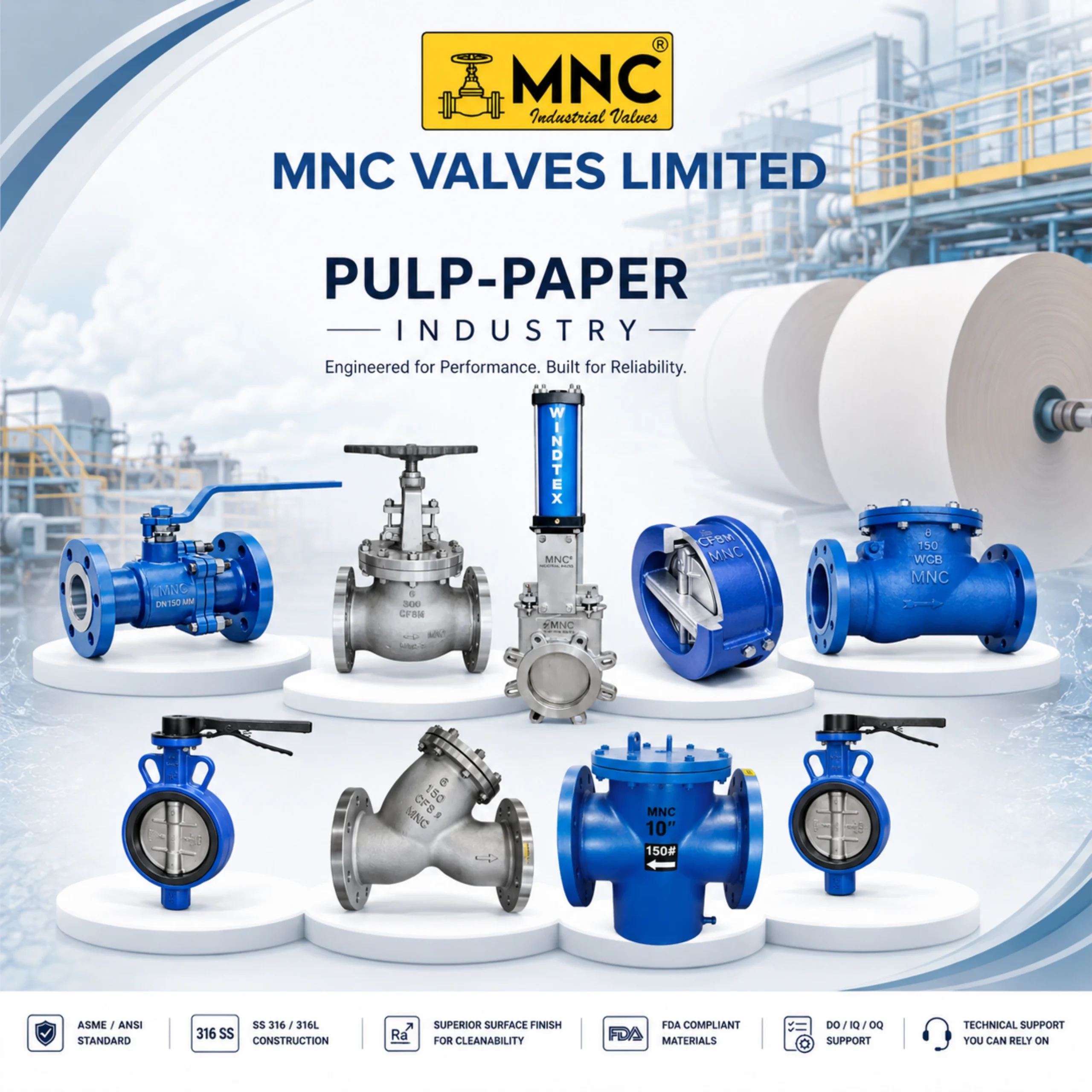
The pulp and paper industry operates under demanding industrial conditions involving fibrous slurry handling, abrasive media, corrosive bleaching chemicals, steam systems, recovery boilers, chemical processing, wastewater treatment, stock preparation systems, vacuum systems, and continuous paper machine operation.
Industrial valves used in pulp and paper plants directly influence pulp flow stability, paper machine reliability, steam efficiency, process continuity, leakage prevention, bleaching chemical handling safety, slurry transfer reliability, wastewater handling, recovery system performance, machine uptime, maintenance reliability, operational safety, and continuous-duty production stability.
For this reason, valve selection in pulp and paper industries must be based on fibrous slurry handling capability, abrasion resistance, corrosion resistance, chemical compatibility, steam suitability, pressure-temperature compatibility, shut-off integrity, operational reliability, automation compatibility, continuous-duty suitability, clogging resistance, and fiber build-up prevention.
Pulp and paper manufacturing involves multiple interconnected process areas where industrial valves perform isolation, slurry transfer, pressure regulation, steam distribution, condensate handling, bleaching chemical transfer, wastewater management, and operational safety functions.
Chip handling, process water, raw material transfer, utility systems, and slurry preparation applications.
Pulp consistency, fiber mixing, dilution water, circulation systems, and process stability.
Digesters, process liquors, caustic chemicals, elevated temperatures, and fibrous slurry transfer.
Bleaching chemical transfer, dosing systems, corrosion resistance, and leakage prevention.
Process water, steam, condensate, vacuum systems, automation, and continuous-duty operation.
Black liquor, recovery boilers, wastewater transfer, sludge handling, and filtration systems.
Wood preparation systems handle wood chips, process water, and raw material transfer before pulping operations.
Wood preparation systems require dependable valve performance for continuous material handling operations, large pipeline suitability, low pressure drop, and operational reliability.
Stock preparation systems control pulp consistency, fiber mixing, dilution water, circulation systems, and pulp preparation before paper machine operations.
Stable stock preparation improves paper quality consistency, fiber control, flow stability, and paper machine performance.
Chemical pulping systems involve chemical digestion processes using caustic chemicals, process liquors, elevated temperatures, and fibrous pulp slurry.
Pulping systems require suitable valve materials and sealing arrangements due to chemical exposure, elevated temperature service, and fibrous media.
Pulp washing and screening systems separate fibers, contaminants, and process residues while maintaining pulp quality and process stability.
Knife gate valves are commonly preferred in pulp slurry applications due to their suitability for fibrous media and suspended solids.
Bleaching systems use chemicals such as chlorine dioxide, peroxide, alkali compounds, and bleaching agents to improve pulp brightness and paper quality.
Bleaching systems often require corrosion-resistant materials and lined valve configurations due to aggressive chemical exposure.
Paper machines operate continuously and require stable process flow, steam systems, condensate handling, pressure control, vacuum systems, and automation reliability.
Paper machine systems require dependable valve performance to maintain production continuity and paper quality consistency.
Vacuum systems are critical in paper machines for dewatering, moisture control, sheet formation, and process efficiency.
Vacuum system stability directly affects paper quality and machine performance.
Steam systems are critical in pulp and paper plants for drying, heating, pulping operations, and paper machine processes.
Reliable steam and condensate control improve thermal efficiency and production stability.
Chemical recovery systems recover process chemicals and improve operational efficiency in pulp mills.
Chemical recovery systems require suitable materials and dependable sealing performance.
Black liquor systems involve abrasive, corrosive, and elevated temperature process media generated during chemical pulping operations.
Black liquor systems require dependable sealing and suitable material selection due to aggressive operating conditions.
Recovery boiler systems operate under elevated temperatures and demanding pressure conditions involving steam generation and process recovery operations.
Recovery boiler systems require dependable valve performance under demanding thermal conditions.
Pulp and paper plants generate wastewater containing fibers, suspended solids, sludge, process contaminants, and chemical residues.
Wastewater systems require dependable valve performance under abrasive and fibrous process conditions.
Pulp and paper industries involve continuous exposure to fibrous pulp slurry, suspended solids, bleaching chemicals, abrasive media, steam systems, condensate systems, wastewater contaminants, elevated temperatures, fiber build-up risk, and cavitation risk.
Fibrous pulp media requires suitable valve construction and sealing arrangement.
Bleaching chemicals and process chemicals require corrosion-resistant materials.
Incorrect valve design may lead to clogging and operational instability.
Improper flow control may cause cavitation damage and premature wear.
Suspended solids and slurry conditions require abrasion-aware valve selection.
Paper plants require dependable valve operation to avoid costly machine shutdowns.
Correct valve selection depends on media type, slurry condition, chemical exposure, temperature requirement, and process criticality.
| Function | Common Valve Type |
|---|---|
| Isolation | Ball Valve / Gate Valve |
| Steam Control | Globe Valve |
| Fibrous Slurry Handling | Knife Gate Valve |
| Chemical Service | Lined Ball Valve |
| Wastewater Handling | Butterfly Valve |
| Backflow Prevention | Check Valve |
| Vacuum Control | Control Valve |
| Valve Type | Typical Application | Key Advantages | Limitations |
|---|---|---|---|
| Butterfly Valve | Water & wastewater systems | Lightweight & economical | Limited abrasive throttling |
| Ball Valve | Chemical & utility systems | Tight sealing & fast operation | Not ideal for heavy throttling |
| Globe Valve | Steam & process control | Accurate throttling | Higher pressure drop |
| Knife Gate Valve | Fibrous slurry handling | Suitable for slurry & suspended solids | Limited high-pressure suitability |
| Check Valve | Pump protection | Prevents reverse flow | No flow regulation |
| Control Valve | Process automation | Accurate modulation & control | Higher complexity |
Material selection is critical due to chemical exposure, fibrous slurry, steam systems, bleaching chemicals, and wastewater handling.
| Material | Typical Application |
|---|---|
| Cast Iron | Utility water systems |
| Ductile Iron | Water & wastewater systems |
| WCB | General process systems |
| CF8 | Mild corrosive applications |
| CF8M | Corrosive chemical service |
| PTFE / PFA Lined | Aggressive bleaching chemicals |
| Stainless Steel | Steam & process utility systems |
Material suitability must consider chemical compatibility, steam exposure, abrasion resistance, slurry suitability, thermal stability, and wastewater exposure.
Modern pulp and paper plants increasingly use automated valves for process control, steam regulation, paper machine operation, stock consistency control, vacuum systems, and chemical dosing systems.
Used where frequent operation, fast response, and process automation are required.
Used where remote operation, panel integration, and controlled movement are required.
Used where flow modulation, steam control, pressure regulation, or consistency control is required.
Improper materials may fail under bleaching chemical exposure or slurry conditions.
Fibrous media require suitable valve construction and sealing arrangements.
Steam systems require pressure-temperature suitable valve materials.
Wastewater sludge systems require suitable slurry-handling valve design.
Incorrect valve design may lead to clogging and operational instability.
Improper flow control may cause cavitation damage and premature wear.
| Application | Common Valve Type |
|---|---|
| Pulp Slurry Systems | Knife Gate Valve |
| Steam Systems | Globe Valve |
| Bleaching Plants | Lined Ball Valve |
| Wastewater Systems | Butterfly Valve |
| Chemical Dosing Systems | Ball Valve |
| Recovery Boiler Systems | Globe Valve |
| Paper Machine Systems | Control Valve |
| Condensate Systems | Check Valve |
| Vacuum Systems | Control Valve |
| Black Liquor Systems | Knife Gate Valve |
MNC Valves Limited supports pulp and paper industries with industrial valve solutions designed for pulp slurry handling, steam systems, bleaching plants, wastewater treatment systems, stock preparation systems, vacuum systems, and paper machine operations.
Valve selection considers pulp slurry, suspended solids, and fiber build-up risk.
Material selection is reviewed according to bleaching chemicals and wastewater conditions.
Steam and condensate applications require pressure-temperature suitable valve performance.
Actuated and control valve options support paper machine process automation.
Valve recommendations consider paper machine uptime and production continuity.
Selection is based on actual media, pressure, temperature, and process conditions.
If you require industrial valves for pulp and paper industry applications, MNC Valves Limited can assist in selecting valve type, body material, seat material, slurry suitability, chemical compatibility, steam suitability, automation option, wastewater suitability, and vacuum system suitability.
Please share your BOQ, P&ID, operating pressure, operating temperature, media details, chemical details, automation requirement, and project specifications for technical guidance and quotation support.
Valve recommendations on this page are provided as general engineering guidance for pulp and paper industry applications.
Final valve selection should always be verified according to process conditions, operating pressure, operating temperature, slurry characteristics, chemical exposure, engineering specifications, customer standards, and safety requirements.
Correct engineering evaluation is essential for reliable pulp and paper plant operation.