
Understanding pressure classes, temperature derating, material limitations, seat ratings, flange compatibility, and safe industrial valve selection.
Pressure Class does not directly mean PSI or bar. A valve’s allowable pressure depends on temperature, material of construction, applicable standards, seat material, flange compatibility, and actual service conditions.
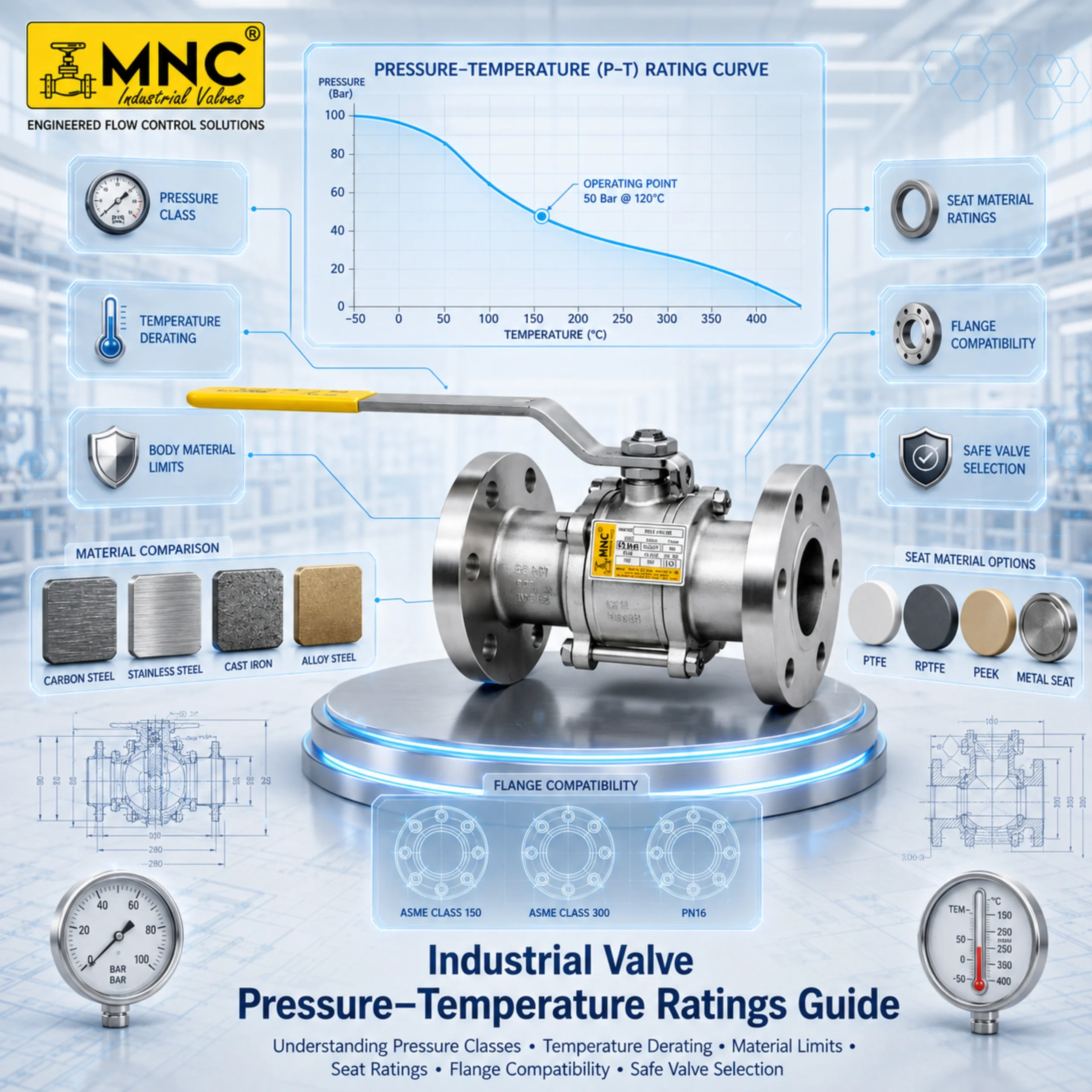
Pressure–temperature ratings define how much pressure a valve can safely handle at a particular operating temperature. These ratings are important because industrial valves operate under real plant conditions where pressure, temperature, material strength, sealing design, seat material, corrosion, and safety factors all affect performance.
A valve that is suitable at room temperature may not remain suitable at elevated temperature. As temperature increases, material strength may reduce and the allowable pressure rating may also reduce. This is why pressure and temperature should always be evaluated together.
Correct pressure–temperature evaluation helps protect pipelines, operators, equipment, pressure boundaries, and plant operation.
Proper rating selection helps reduce leakage, deformation, premature failure, repeated maintenance, and unexpected shutdowns.
Pressure–temperature ratings give engineers, consultants, inspectors, and buyers a consistent technical basis for valve selection.
Pressure rating should not be checked only against normal operating pressure. It should be checked at actual operating temperature and according to material, pressure class, seat limitation, flange compatibility, and applicable project requirements.
Pressure Class is a standardized rating category used for valves, flanges, and piping components. Common industrial valve pressure classes include Class 150, 300, 600, 900, 1500, and 2500. Some special high-pressure applications may also use higher classes such as Class 4500.
Pressure Class gives a general rating family, but it does not directly define the maximum working pressure at every temperature. The actual allowable pressure depends on material, temperature, applicable standard, and complete valve construction.
Pressure Class helps define the rating category, but the exact allowable pressure should always be checked against material, temperature, valve design, and relevant engineering reference.
One of the most common mistakes in valve selection is assuming that Class 150 means 150 PSI or Class 300 means 300 PSI. This is incorrect. Pressure Class is not a direct pressure value.
A Class 150 valve may have an allowable pressure higher than 150 PSI at lower temperatures, depending on material and standard reference. However, allowable pressure may reduce as temperature increases.
Never select a valve only by assuming Class 150 = 150 PSI or Class 300 = 300 PSI. This misunderstanding may result in wrong valve selection, unsafe operation, over-specification, under-specification, or unnecessary cost.
Before final valve selection, always check the actual service conditions: operating pressure, operating temperature, valve material, seat material, end connection, and application severity.
Pressure Class, Pressure Rating, and Design Pressure are closely related, but they are not the same thing. Confusing these terms can create serious specification mistakes during valve selection and procurement.
A professional valve selection process should clearly identify all three: the pressure class of the valve, the allowable pressure rating at actual temperature, and the design pressure specified for the system.
Many buyers select valves only by pressure class without checking whether the allowable pressure rating at operating temperature is suitable for the design pressure of the system.
A standardized rating category used for valves and flanges.
The allowable pressure for a specific material at a specific temperature.
The pressure value selected by the project engineer for system design.
| Term | Meaning | Decided By | Purpose |
|---|---|---|---|
| Pressure Class | Rating Category | Engineering Standard | Valve / Flange Classification |
| Pressure Rating | Allowable Pressure At Temperature | Material + Temperature + Standard | Safe Operating Limit |
| Design Pressure | System Design Basis | Project Engineer | Equipment & System Design |
Pressure Class is the category, Pressure Rating is the allowable limit at temperature, and Design Pressure is the project requirement. Correct selection requires all three to be checked together.
Pressure and temperature are directly connected in valve engineering. As operating temperature increases, many valve materials gradually lose strength. Because of this reduction in material strength, the allowable pressure rating also reduces.
This relationship is the foundation of pressure-temperature rating charts and explains why a valve that is suitable at room temperature may not be suitable at elevated temperature.
Higher Temperature → Lower Material Strength → Lower Allowable Pressure
Material strength generally remains higher, so allowable pressure capacity is usually higher.
Allowable pressure may begin to reduce depending on material and rating class.
Significant pressure derating may be required and engineering verification becomes essential.
Never evaluate pressure alone. Always evaluate pressure together with temperature, material, seat design, and application severity before final valve selection.
Pressure derating is the process of reducing allowable pressure as operating temperature increases. This is a normal engineering principle and applies to most industrial valve materials including carbon steel, stainless steel, alloy steel, and many special alloys.
As temperature rises, the mechanical properties of materials gradually change. Yield strength, tensile strength, and pressure boundary capability may reduce. To maintain safety and reliability, allowable pressure ratings are reduced accordingly.
Pressure derating is not a manufacturing limitation. It is a scientifically established engineering practice used to maintain safe operation at elevated temperatures.
As temperature increases, the material's resistance to permanent deformation gradually decreases.
The maximum stress a material can withstand before failure may reduce at elevated temperatures.
Derating helps maintain structural integrity throughout the valve's operating temperature range.
A pressure-temperature chart is essentially a derating chart. It helps engineers understand how allowable pressure changes as operating temperature increases.
ASME B16.34 is one of the most widely recognized engineering standards used in industrial valve manufacturing and selection. It provides requirements related to pressure-temperature ratings, wall thickness, pressure boundary design, materials, inspection, testing, and marking requirements.
Many industrial valve pressure-temperature references are based on principles established within ASME B16.34. Engineers commonly use this standard when evaluating whether a valve is suitable for a particular pressure and temperature condition.
This page is an educational engineering guide and does not reproduce official ASME B16.34 pressure-temperature tables. Actual engineering decisions should always be verified using approved standards, project specifications, and manufacturer documentation.
| ASME B16.34 Area | Purpose | Engineering Benefit |
|---|---|---|
| Pressure-Temperature Ratings | Allowable Operating Limits | Safe Valve Selection |
| Material Classification | Material Evaluation | Consistent Rating System |
| Wall Thickness Requirements | Pressure Containment | Structural Integrity |
| Inspection Requirements | Quality Verification | Reliability Assurance |
| Marking Requirements | Valve Identification | Traceability |
ASME B16.34 is not merely a pressure chart. It is a comprehensive engineering framework that supports safe valve design, manufacturing, inspection, identification, and pressure-temperature evaluation.
Pressure–temperature ratings are not based on a single engineering document. They are established through a combination of internationally recognized standards covering valve design, flange compatibility, material specifications, testing requirements, manufacturing practices, and application-specific requirements.
Understanding how these standards work together helps engineers, consultants, buyers, and plant operators make informed valve selection decisions.
A pressure-temperature value shown on a chart is only the final result. Behind that value are multiple engineering standards governing materials, pressure boundaries, testing requirements, and design principles.
Professional valve selection requires evaluation of materials, standards, operating conditions, testing requirements, and application-specific demands. Pressure-temperature ratings represent the combined outcome of these engineering considerations.
Pressure-temperature ratings are closely related to material selection. Different materials possess different mechanical properties and therefore different allowable pressure capabilities at various temperatures.
To simplify engineering evaluation, valve materials are commonly grouped according to their mechanical and metallurgical characteristics.
Two valves with the same pressure class may have different allowable pressure capabilities because they are manufactured from different material groups.
Carbon Steel & Low Alloy Steel Materials
Stainless Steel & Duplex Materials
Nickel & Special Alloy Materials
| Material Group | Typical Materials | Typical Service | Primary Advantage |
|---|---|---|---|
| Group 1 | WCB, A105 | General Industrial Service | Strength & Economy |
| Group 2 | CF8, CF8M, F304, F316 | Corrosive Applications | Corrosion Resistance |
| Group 3 | Monel, Inconel, Hastelloy | Severe Chemical Service | Extreme Corrosion Resistance |
Material grouping simplifies pressure-temperature evaluation, but final valve selection must still consider actual material grade, operating pressure, temperature, corrosion potential, process fluid, and application severity.
Material selection is one of the most important factors affecting valve performance, pressure capability, corrosion resistance, service life, maintenance requirements, and overall reliability. Selecting the correct material requires evaluation of process fluid, operating temperature, pressure conditions, corrosion potential, environmental exposure, and project requirements.
Different materials respond differently to temperature changes, corrosive environments, erosion, pressure cycling, and long-term service conditions. Therefore, material selection should always be performed before evaluating pressure-temperature suitability.
The strongest material is not always the best material. The correct material is the one that safely satisfies process conditions while providing reliability, service life, maintainability, and economic value.
Carbon Steel
Stainless Steel 304 Equivalent
Stainless Steel 316 Equivalent
Forged Carbon Steel
Forged Stainless Steel 304
Forged Stainless Steel 316
| Material | Common Name | Typical Service | Primary Advantage |
|---|---|---|---|
| A216 WCB | Carbon Steel | General Industry | Strength & Economy |
| A351 CF8 | SS304 | Water & Food | Corrosion Resistance |
| A351 CF8M | SS316 | Chemical Service | Enhanced Corrosion Resistance |
| A105 | Forged Carbon Steel | Pressure Service | High Integrity |
| F304 | Forged SS304 | Process Service | Corrosion Resistance |
| F316 | Forged SS316 | Aggressive Service | Superior Corrosion Resistance |
| Duplex | Duplex Stainless Steel | Offshore | Strength + Corrosion Resistance |
| Monel | Nickel Alloy | Marine Service | Chemical Resistance |
| Hastelloy | High Alloy | Severe Chemical Service | Extreme Resistance |
One of the most overlooked areas in valve selection is the difference between body rating and seat rating. Many users evaluate only the valve body material and assume the valve is suitable for the application. In reality, seat material limitations frequently determine the actual operating capability of the valve.
A valve body may be capable of operating at elevated temperatures and pressures, while the seat material may impose significantly lower operating limits.
A valve is only as capable as its most limiting component. In many cases, seat material limitations determine the practical operating range long before the body material reaches its maximum allowable capability.
| Seat Material | Typical Characteristics | Common Applications |
|---|---|---|
| PTFE | Excellent sealing and low friction | General Industrial Service |
| RPTFE | Improved wear resistance and strength | Higher Duty Applications |
| PEEK | Higher temperature capability | Severe Process Service |
| EPDM | Good water compatibility | Water Treatment Systems |
| NBR | Good oil resistance | Utility & Oil Service |
| Graphite | High temperature sealing | Steam Service |
| Metal Seat | Extreme temperature capability | Severe Service Applications |
Always evaluate body material and seat material together. In many real-world applications, seat material limitations determine the maximum practical operating temperature long before the body material reaches its allowable pressure-temperature limit.
A valve does not operate alone. It becomes part of a complete pressure boundary system consisting of valves, flanges, gaskets, bolting, piping components, and connected equipment. For safe operation, all connected components should be compatible with the intended pressure and temperature conditions.
Even if a valve has sufficient pressure-temperature capability, the overall system may become limited by the flange rating, gasket selection, bolting arrangement, or another connected component.
The maximum allowable pressure of a system can never exceed the rating of its lowest-rated component.
All components should be evaluated together.
| Valve Class | Typical Flange Class | Engineering Review Required |
|---|---|---|
| 150# | 150# | Temperature Verification |
| 300# | 300# | Pressure-Temperature Review |
| 600# | 600# | System Compatibility Check |
| 900# | 900# | Detailed Engineering Review |
| 1500# | 1500# | Critical Service Evaluation |
| 2500# | 2500# | High Energy Service Review |
Correct valve selection requires evaluation of the complete pressure boundary system rather than reviewing the valve alone.
The following charts are simplified engineering references intended to demonstrate the relationship between pressure, temperature, material selection, and valve ratings. They help users understand pressure derating concepts and the effect of temperature on allowable pressure capability.
These charts are simplified educational references and should not be interpreted as official ASME pressure-temperature tables. Actual allowable pressure values depend on material grade, pressure class, valve design, seat material, operating conditions, applicable standards, and manufacturer documentation.
Illustrative educational reference showing how allowable pressure capability generally decreases as operating temperature increases.
| Temperature (°C) | Typical Relative Pressure Capability |
|---|---|
| 38 | High |
| 100 | Moderately High |
| 200 | Moderate |
| 300 | Reduced |
| 400 | Further Reduced |
Illustrative educational reference showing pressure capability trends with increasing temperature.
| Temperature (°C) | Typical Relative Pressure Capability |
|---|---|
| 38 | High |
| 100 | High |
| 200 | Moderately High |
| 300 | Moderate |
| 400 | Reduced |
The educational charts presented on this page are intended to illustrate engineering principles only. They should not be used as the sole basis for valve selection, procurement, design calculations, safety evaluations, or project approval.
Many users look at pressure-temperature charts but do not know how to interpret them correctly. A professional engineering review should always follow a logical evaluation process rather than looking at a single pressure value.
The objective is not simply to identify a pressure class, but to verify whether the complete valve assembly is suitable for the actual operating conditions.
Selecting a valve based only on pressure class without reviewing temperature, material, seat design, corrosion conditions, and system requirements.
Identify process fluid, pressure, temperature, corrosion potential, and application requirements.
Select appropriate body material and seat material based on service conditions.
Verify that pressure class and pressure-temperature capability satisfy operating requirements.
Pressure-temperature charts should be treated as one input among many. Material compatibility, seat limitations, corrosion resistance, and project specifications remain equally important.
The following example demonstrates a simplified engineering review process. The purpose is to show how pressure, temperature, material selection, and valve rating are evaluated together.
The example below is intended for understanding the evaluation process and should not replace detailed engineering review or project-specific calculations.
Confirm WCB material is suitable for the process fluid and operating environment.
Check pressure class and pressure-temperature suitability at the actual operating temperature.
Verify seat material, flange compatibility, testing requirements, and project specifications.
| Evaluation Item | Engineering Review |
|---|---|
| Process Fluid | Material Compatibility Review |
| Operating Pressure | Pressure Rating Verification |
| Operating Temperature | Temperature Capability Review |
| Seat Material | Sealing Suitability Check |
| Flanges | Class Compatibility Check |
| Project Requirements | Final Engineering Approval |
Professional valve selection is a process, not a single pressure-class decision. Multiple engineering factors should be evaluated together before final approval.
Forged steel valves are widely used in high-pressure and severe-service applications. Unlike standard flange classes commonly seen in ASME B16.5 systems, forged valve classes are often identified using designations such as Class 800, Class 1500, and Class 2500.
These valves are commonly found in refinery systems, petrochemical plants, power generation facilities, steam systems, and critical industrial applications where high integrity pressure boundaries are required.
Class 800 should not be interpreted as 800 PSI. It is a forged valve pressure class designation and should always be evaluated according to applicable standards and manufacturer documentation.
| Forged Valve Class | Typical Use | Application Severity |
|---|---|---|
| 800 | General High Pressure Service | Moderate to High |
| 1500 | Critical Pressure Systems | High |
| 2500 | Severe Duty Applications | Very High |
Forged valve classes should always be evaluated using the applicable valve standard, material specification, pressure-temperature requirements, and manufacturer documentation rather than relying solely on class designation.
Pressure-temperature ratings influence valve selection across virtually every industrial sector. Different industries operate under different pressure ranges, temperatures, process conditions, and material compatibility requirements.
Many valve selection problems originate from simple but important engineering mistakes. Understanding these common errors helps improve reliability, safety, and long-term plant performance.
Assuming Class 150 means 150 PSI.
Ignoring operating temperature while selecting pressure class.
Reviewing body material but ignoring seat material limitations.
Ignoring flange compatibility and system pressure boundary requirements.
Selecting material based only on pressure without considering corrosion.
Using simplified charts as final engineering design data.
Always review pressure, temperature, material, seat design, flange compatibility, process fluid, corrosion potential, testing requirements, and project specifications together before final valve selection.
Class 150 is a pressure class designation and does not directly mean 150 PSI.
Because material strength generally reduces as temperature increases.
No. Material, temperature, seat design, and application requirements must also be reviewed.
Pressure derating is the reduction of allowable pressure as temperature increases.
Seat material may limit the practical operating range even when the body material remains suitable.
Yes. Different materials may have different pressure-temperature capabilities.
No. The charts on this page are simplified educational references.
Yes. Final ratings should always be verified using approved engineering references and manufacturer documentation.
Selecting the correct valve requires more than reviewing a pressure class. Our engineering team can assist in evaluating process conditions, pressure-temperature requirements, materials, seat designs, flange compatibility, and application suitability.
Receive engineering guidance on valve suitability, materials, and operating conditions.
Get assistance with valve selection, pressure class evaluation, and material recommendations.
Consult our engineering team regarding severe service, automation, corrosion, temperature, and pressure requirements.
The information presented on this page is intended for educational and general engineering awareness purposes only. It is designed to help readers understand pressure-temperature relationships, pressure classes, material selection considerations, seat limitations, and valve engineering principles.
The charts and examples presented on this page are simplified educational references and should not be interpreted as official ASME pressure-temperature tables or certified engineering design data.
Actual allowable pressure ratings depend on material grade, pressure class, valve design, seat material, operating conditions, corrosion environment, project specifications, applicable standards, and manufacturer documentation.
Final valve selection, engineering approval, procurement decisions, safety evaluations, and design calculations should always be based on approved engineering standards, project requirements, and manufacturer documentation.
Always verify pressure-temperature suitability before installation, procurement, design approval, or safety-critical application.