
Industrial valve engineering guide for cement plants, kiln systems, clinker handling, pneumatic conveying, air slide systems, dust collection systems, compressed air systems, and heavy-duty cement process applications.
Cement plants operate under severe industrial conditions involving abrasive cement powder, clinker exposure, high temperatures, pneumatic conveying systems, dust handling systems, and continuous heavy-duty plant operation.
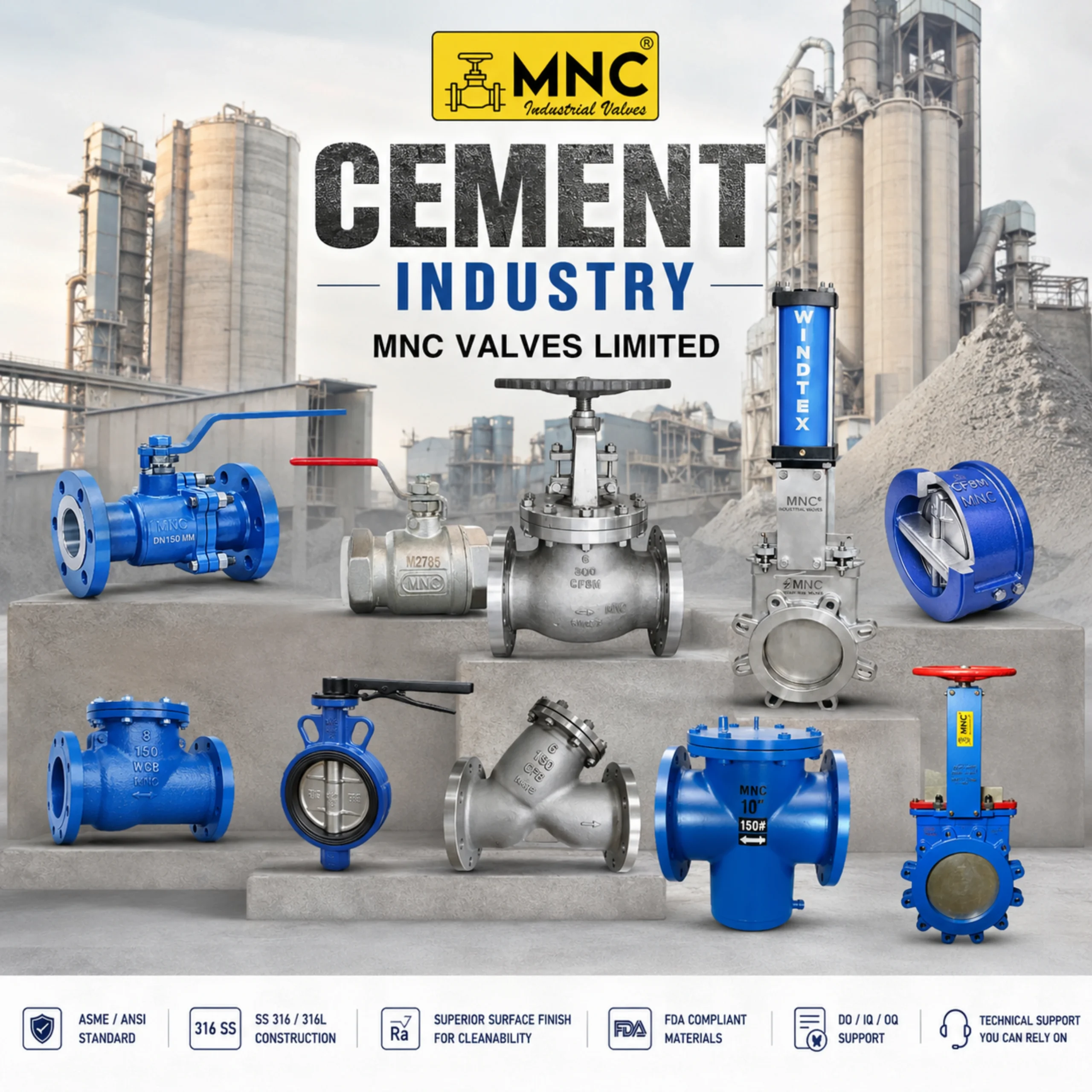
The cement industry operates under extremely demanding industrial conditions involving abrasive cement powder, clinker handling, high-temperature systems, pneumatic conveying, dust collection systems, compressed air systems, air slide systems, fuel handling systems, slurry handling, vibrating process lines, thermal expansion conditions, and continuous heavy-duty plant operation.
Industrial valves used in cement plants directly influence production continuity, kiln stability, pneumatic conveying efficiency, dust handling reliability, compressed air performance, clinker handling operations, shutdown prevention, process safety, maintenance reliability, operational efficiency, energy utilization, and continuous-duty plant performance.
For this reason, valve selection in cement industries must be based on abrasion resistance, erosion resistance, high-temperature suitability, powder handling capability, pneumatic conveying compatibility, shut-off integrity, pressure-temperature compatibility, operational reliability, automation compatibility, continuous-duty suitability, dust leakage prevention, compressed air stability, vibration resistance, and thermal expansion suitability.
Cement manufacturing involves multiple interconnected process areas where industrial valves perform isolation, air flow regulation, pneumatic conveying control, slurry transfer, compressed air management, dust handling, process safety, and operational control functions.
Raw material transfer, raw mill systems, utility systems, and process circulation applications.
Kiln systems, burner systems, fuel handling systems, and clinker cooler applications.
Cement powder transfer, air slide systems, diverter valves, and compressed air systems.
Grinding systems, separator systems, silo discharge systems, and packing plants.
Bag filters, baghouse isolation systems, dust extraction systems, and airflow control systems.
Compressed air systems, slurry systems, wastewater handling, and utility applications.
Raw material handling systems transport limestone, clay, gypsum, and process additives through conveyors, transfer systems, and utility pipelines.
Raw material systems require dependable valve performance for continuous-duty operation.
Raw mill systems process and transport raw materials before clinker production operations.
Raw mill systems require dependable valve operation under abrasive operating conditions.
Kiln systems operate under extremely high temperatures and are critical for clinker production processes.
Kiln systems require dependable valve performance under demanding thermal conditions.
Fuel handling systems manage coal, pet coke, fuel oil, natural gas, and alternative fuel systems used in cement kiln operations.
Fuel handling systems require dependable valve operation for safe kiln operation and combustion stability.
Clinker cooler systems manage hot clinker cooling operations and air circulation systems.
Clinker cooling systems require stable airflow management and dependable valve performance.
Pneumatic conveying systems transport cement powder, fly ash, and process materials using compressed air systems.
Compressed air leakage in pneumatic conveying systems may reduce conveying efficiency, increase energy consumption, and affect process stability.
Diverter valves, rotary airlock valves, rotary feeders, and control dampers are commonly used in cement plants for material routing, controlled discharge, and pneumatic conveying stability.
Air slide systems are widely used in cement plants for low-pressure powder conveying between silos, hoppers, packing systems, and transfer points.
Air slide systems require dependable valve operation to maintain stable cement transfer and process continuity.
Cement grinding systems involve material circulation, process air systems, and abrasive powder handling operations.
Grinding systems require dependable valve operation under abrasive process conditions.
Silo and packing systems handle cement storage, discharge control, and final product handling operations.
Pressure vacuum relief systems are commonly used on cement silos to maintain safe pressure balance and operational protection.
Packing plant systems require reliable valve performance to maintain uninterrupted dispatch operations.
Dust collection systems are critical in cement plants for environmental control, process efficiency, and operational safety.
Severe dust leakage may create housekeeping issues, environmental compliance risks, maintenance burden, compressed air losses, and operational inefficiency.
Dust collection systems require dependable valve performance to maintain environmental compliance and process stability.
Compressed air systems support pneumatic conveying, instrumentation, utility operation, and automation systems across cement plants.
Compressed air systems require dependable sealing and operational stability.
Cement plants generate wastewater and slurry systems involving suspended solids, abrasive particles, and process contaminants.
Wastewater systems require dependable valve performance under abrasive process conditions.
Cement terminals and bulk loading systems handle cement transfer for truck loading, rail dispatch, ship loading, and bulk storage operations.
Bulk handling systems require dependable valve operation for uninterrupted cement transfer and dispatch continuity.
Cement industries involve severe operating conditions including abrasive cement powder, clinker exposure, elevated temperatures, suspended dust particles, pneumatic conveying systems, compressed air systems, thermal cycling, erosion risk, vibration exposure, and mechanical stress conditions.
Continuous exposure to abrasive cement powder may rapidly damage unsuitable valve internals, sealing surfaces, and flow control components.
Abrasive media may damage valve internals, seats, and sealing surfaces under continuous-duty operation.
Kiln systems and clinker handling systems require suitable thermal stability and pressure-temperature compatibility.
Dust leakage may create housekeeping issues, maintenance burden, and environmental compliance problems.
Pneumatic conveying systems may cause erosion damage under high-velocity powder handling conditions.
Cement plants commonly involve vibration exposure, thermal expansion conditions, and heavy-duty mechanical stress.
Unexpected valve failures may result in kiln shutdowns, production losses, and operational downtime.
Correct valve selection depends on media type, temperature condition, powder handling requirement, pressure condition, and process criticality.
| Function | Common Valve Type |
|---|---|
| Isolation | Ball Valve / Gate Valve |
| Pneumatic Conveying | Butterfly Valve |
| Powder Handling | Slide Gate Valve |
| Slurry Handling | Knife Gate Valve |
| Airflow Regulation | Globe Valve |
| Backflow Prevention | Check Valve |
| Valve Type | Typical Application | Key Advantages | Limitations |
|---|---|---|---|
| Butterfly Valve | Pneumatic conveying systems | Lightweight & economical | Limited heavy throttling |
| Ball Valve | Compressed air systems | Tight sealing & fast operation | Not ideal for abrasive throttling |
| Globe Valve | Airflow regulation | Accurate throttling | Higher pressure drop |
| Knife Gate Valve | Slurry handling | Suitable for abrasive media | Limited high-pressure suitability |
| Gate Valve | Isolation service | Full bore flow | Slower operation |
| Check Valve | Pump protection | Prevents reverse flow | No flow regulation |
Material selection is critical due to abrasive media, elevated temperatures, cement powder exposure, and compressed air systems.
| Material | Typical Application |
|---|---|
| Cast Iron | Utility systems |
| Ductile Iron | Air & water systems |
| WCB | General cement plant service |
| CF8 | Mild corrosive applications |
| CF8M | Corrosive utility systems |
| Stainless Steel | Compressed air & utility systems |
| Hard-Faced Components | Abrasive service conditions |
Material suitability must consider abrasion resistance, erosion resistance, thermal stability, compressed air compatibility, dust exposure, and process pressure conditions.
Modern cement plants increasingly use automated valves for process control, pneumatic conveying systems, compressed air systems, dust collection systems, airflow modulation, burner control systems, and utility operations.
Used where frequent operation, fast response, and pneumatic automation are required.
Used where remote operation, panel integration, and controlled movement are required.
Used where airflow modulation, burner control, compressed air regulation, and process stability are required.
Improper materials may fail under abrasive cement powder exposure.
Pneumatic conveying systems require erosion-resistant valve construction.
Kiln systems require pressure-temperature suitable valve materials.
Powder systems require suitable sealing arrangements and airflow control capability.
Dust handling systems require dependable sealing performance.
Improper sizing may affect pneumatic conveying efficiency and operational stability.
| Application | Common Valve Type |
|---|---|
| Pneumatic Conveying Systems | Butterfly Valve |
| Kiln Systems | Globe Valve |
| Cement Powder Handling | Slide Gate Valve |
| Slurry Handling Systems | Knife Gate Valve |
| Compressed Air Systems | Ball Valve |
| Dust Collection Systems | Butterfly Valve |
| Packing Plant Systems | Ball Valve |
| Wastewater Systems | Knife Gate Valve |
MNC Valves Limited supports cement industries with industrial valve solutions designed for abrasive powder handling, clinker systems, pneumatic conveying systems, dust collection systems, compressed air systems, and wastewater handling applications.
Valve selection considers abrasive cement powder and heavy-duty process conditions.
Pneumatic conveying systems require erosion-aware valve selection.
Kiln and clinker applications require thermal stability and operational reliability.
Dust handling systems require dependable sealing and operational control.
Actuated valves support pneumatic conveying systems and process automation.
Valve recommendations consider shutdown prevention and production continuity.
If you require industrial valves for cement industry applications, MNC Valves Limited can assist in selecting valve type, body material, seat material, abrasion suitability, erosion resistance, compressed air suitability, automation option, and pneumatic conveying suitability.
Please share your BOQ, P&ID, operating pressure, operating temperature, media details, automation requirement, and project specifications for technical guidance and quotation support.
Valve recommendations on this page are provided as general engineering guidance for cement industry applications.
Final valve selection should always be verified according to process conditions, operating pressure, operating temperature, abrasive exposure, engineering specifications, customer standards, and safety requirements.
Correct engineering evaluation is essential for reliable cement plant operation.