
MNC Valves Ltd.
MNC VALVES LIMITED manufactures high-performance 3 Way Screwed Ball Valves designed for compact multi-directional flow control, diverting, switching, and mixing applications in utility, process, OEM, and industrial systems.
25+ Years Experience in industrial valve manufacturing and supply
Size range available from DN15 to DN50
Available in L Port and T Port configurations
Compact threaded-end solution for multi-line control in smaller systems
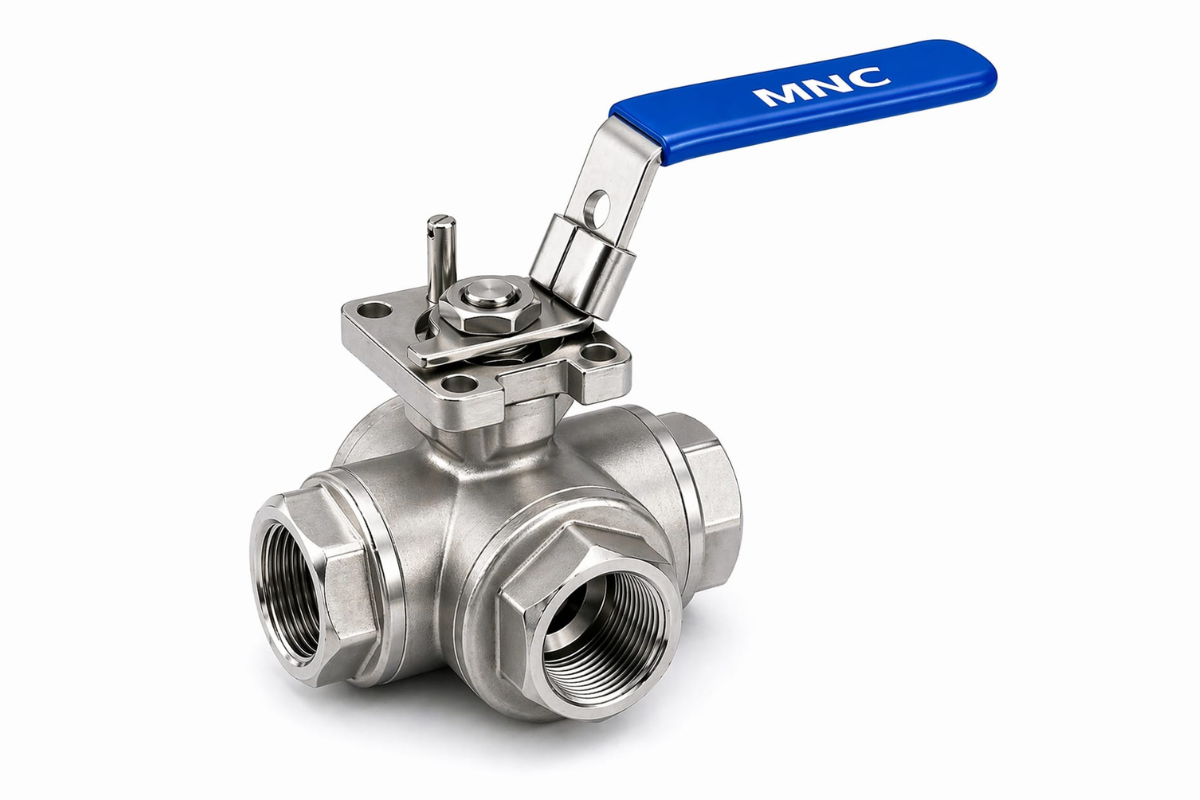
MNC VALVES LIMITED is a trusted manufacturer and supplier of 3 Way Screwed Ball Valves engineered for compact multi-directional flow control where threaded end installation is preferred. These valves are widely used in systems requiring flow diverting, flow switching, or mixing through a space-saving valve arrangement.
The 3 way screwed design offers the flexibility of multi-port control with the convenience of threaded-end installation, making it suitable for utility lines, OEM systems, skid packages, chemical dosing lines, compact process systems, and general industrial service.
A 3 Way Screwed Ball Valve is a quarter-turn multi-port valve with threaded end connections and a specially configured ball that controls flow between three ports. Depending on the internal ball pattern, the valve can switch flow direction, combine streams, or distribute media between connected lines.
This valve category is commonly selected where the buyer needs compact installation, reduced piping complexity, and dependable multi-directional flow control in smaller size process and utility systems.
Specially machined ball porting allows compact flow switching, diverting, and mixing operations.
Suitable for compact systems where screwed-end installation is preferred over flanged connection.
Enables fast and practical multi-line control in compact utility and process applications.
L Port design is mainly used for diverting service. It allows one inlet flow to be directed toward one of two outlet directions depending on valve position.
T Port design is mainly used for mixing and distribution service. It can support combined or split flow paths depending on valve position and internal passage alignment.
Details
3 Way Ball Valve
Screwed End / Threaded End
DN15 to DN50
As per design and application requirement
L Port / T Port
Full Bore / Reduced Bore
BSP / NPT as required
API 598
Lever / Pneumatic / Electric
WCB / CF8 / CF8M
PTFE / RPTFE
3 way screwed ball valves are commonly selected in smaller line sizes where threaded-end installation is suitable. Final pressure suitability depends on body design, thread integrity, size, and actual operating conditions.
Temperature capability depends on seat material and media condition. PTFE and RPTFE are suitable for many compact industrial and utility services, subject to application limits.
Supports advanced flow routing in smaller line systems without requiring multiple separate valves.
Can reduce fittings and valve count in suitable compact process layouts.
Screwed ends support compact integration in OEM, skid, and utility applications.
Suitable where compact multi-directional flow control is needed in integrated assemblies.
Useful where compact switching or mixing duty is required in smaller pipelines.
Applicable where threaded-end installation and compact routing are preferred.
Suitable in smaller process routing systems requiring multi-port control.
Selected where compact installation and material compatibility are important.
Used where one compact valve must perform multi-line flow switching or mixing duty.
Flow Direction
Multi-directional
Single flow path
Main Use
Mixing / diverting / switching
Open-close isolation
Piping Complexity
Reduced in suitable compact layouts
Higher if multiple directions are required
Application Flexibility
Higher
Lower for multi-line control
Industrial product understanding built through long market and application exposure.
Technical guidance for selecting the correct port design and compact threaded-end configuration.
Structured manufacturing and testing approach for dependable compact multi-port valve performance.
Connect with MNC VALVES LIMITED for technical support, port selection guidance, and quotation for your industrial requirement.
Gives the buyer one clear next step
Supports technical and commercial inquiry intent
Reduces confusion after reading the page
Turns content readers into RFQ visitors
It is a multi-port quarter-turn valve with threaded ends, used for mixing, diverting, and switching flow between multiple directions.
The size range for screwed end 3 way ball valves is DN15 to DN50.
L Port is mainly used for diverting service, while T Port is mainly used for mixing or distribution service.
It reduces piping complexity in compact systems where more than one flow direction must be controlled.
BSP and NPT thread standards are commonly used depending on project requirement.
WCB, CF8, and CF8M are commonly used depending on service media and corrosion condition.
PTFE and RPTFE are commonly used depending on temperature and service requirements.
Yes, with suitable stainless steel body and compatible seat material selection.
It is mainly selected for switching, mixing, and diverting service rather than precision throttling duty.
Yes, manual, pneumatic, and electric operated versions can be provided depending on requirement.
OEM systems, skid systems, chemical dosing lines, compressed air systems, utility lines, and process applications commonly use it.
Threaded ends support compact and practical installation in smaller piping systems.
Yes, it can reduce the need for multiple 2-way valves in suitable compact multi-line systems.
The choice depends on whether the application needs diverting duty or mixing/distribution duty.
Periodic inspection of seats, ball surface, stem sealing, and operating smoothness is recommended.
Valve size, pressure, seat material, media condition, and port geometry affect torque requirement.
No, screwed-end designs are generally preferred in smaller sizes, which is why this range is limited to DN15 to DN50.
Yes, it is highly suitable for compact integrated systems and machine-connected flow routing duty.
Because the flow pattern of the valve must match the actual process logic for proper operation.
Because MNC VALVES LIMITED offers application-based port selection support, reliable manufacturing quality, and practical compact multi-port valve solutions.
WhatsApp us