
Industrial valve selection guide for corrosive, hazardous, and process chemical applications. MNC Valves Limited supports chemical industries with application-oriented valve solutions designed for corrosive media handling, chemical transfer, process isolation, automation systems, and aggressive chemical environments.
Chemical processing systems involve corrosive media, aggressive chemicals, high temperatures, pressure variations, automation systems, and critical shut-off applications requiring reliable industrial valve performance.
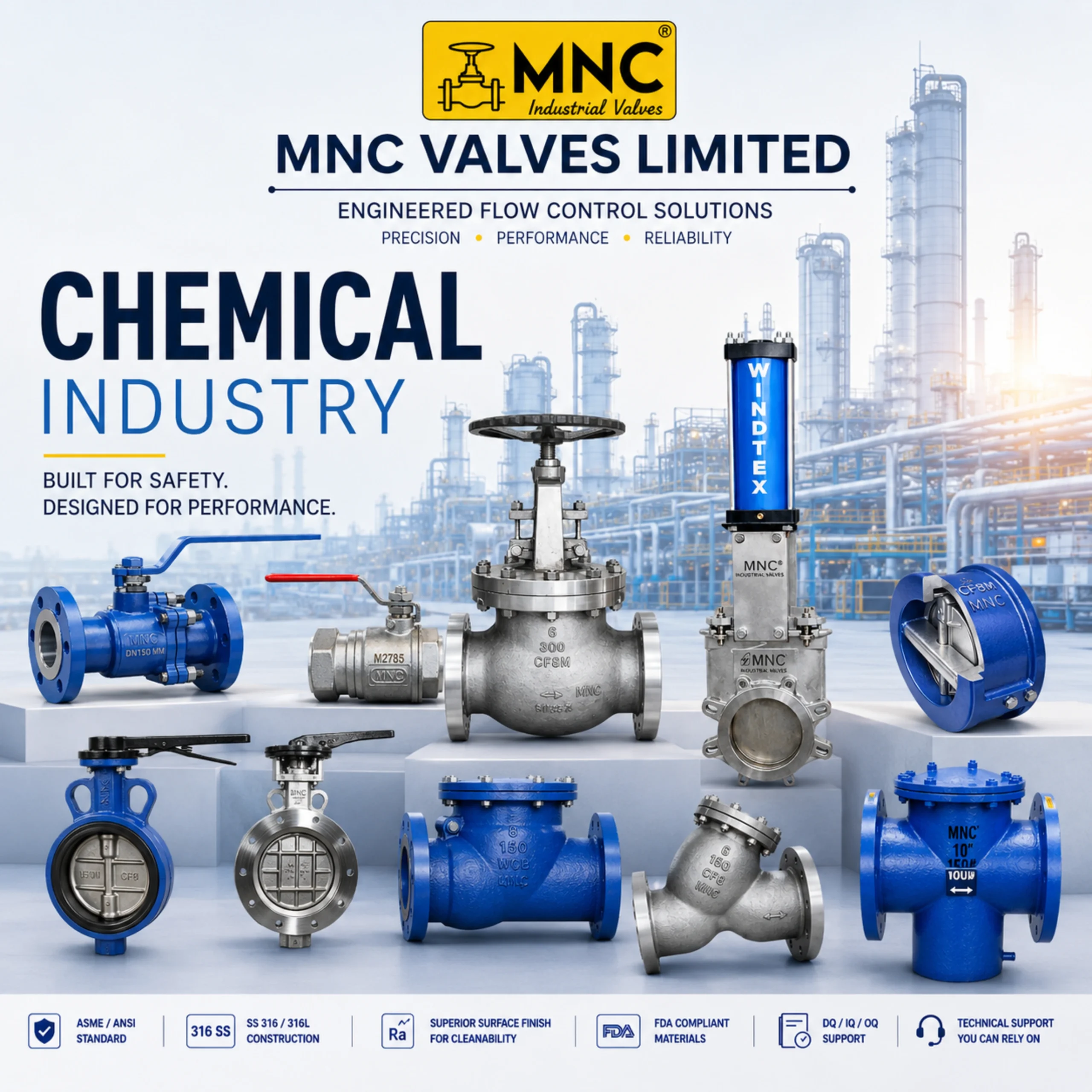
Chemical processing industries operate under some of the most demanding service conditions in industrial environments. Chemical plants involve corrosive media, aggressive chemicals, high-temperature service, pressure variations, toxic fluids, abrasive media, automation systems, and critical shut-off applications.
Industrial valves used in chemical plants directly influence plant safety, leakage control, operational reliability, maintenance frequency, corrosion resistance, process stability, and equipment protection.
For this reason, valve selection in chemical industries must be based on chemical compatibility, process conditions, pressure requirements, corrosion resistance, seat material suitability, sealing performance, automation requirements, and international engineering standards.
Chemical plants involve multiple process stages where valves are used to isolate equipment, regulate flow, control pressure, handle corrosive chemicals, support automation systems, prevent reverse flow, maintain process safety, and control hazardous media.
Chemicals are transferred from storage tanks, drums, or process supply systems into production pipelines.
Corrosive and hazardous media move between reactors, mixers, filtration systems, and process units.
Valves support process control, isolation, utility services, and operational safety systems.
Controlled chemical injection systems require accurate shut-off and flow regulation capability.
Industrial filtration systems require reliable isolation and operational control during maintenance.
Automated valves improve process consistency, remote operation capability, and plant efficiency.
Chemical processing systems often involve acids, alkalis, solvents, oxidizing agents, abrasive media, and high-temperature fluids. Improper valve selection can result in corrosion, leakage, seal failure, operational instability, plant shutdown, and equipment damage.
Material compatibility is one of the most important factors in chemical valve selection.
Different chemical applications require different valve technologies according to media condition, pressure, temperature, shut-off requirement, process criticality, and automation needs.
Used for process isolation, equipment shutdown, maintenance isolation, and tank outlet systems.
Used for acid handling, alkali systems, aggressive chemical pipelines, and chemical transfer systems.
Used for process regulation, dosing systems, controlled chemical transfer, and reactor feed systems.
Used for compressed air, cooling water, utility chemicals, and steam support systems.
Used where reverse flow can damage pumps, dosing systems, or process equipment.
Used where remote control, process sequencing, or repeated operation is required.
Lined valves are widely used in corrosive chemical environments where standard metallic valves may not provide sufficient corrosion resistance. PTFE / PFA lined valves help protect valve body surfaces, internal flow passages, and sealing areas from aggressive chemical attack.
Correct lining material selection depends on chemical compatibility, process temperature, operating pressure, and media concentration.
Material selection is critical in chemical processing applications. Incorrect material selection may lead to corrosion, erosion, leakage, operational instability, and premature valve failure.
| Material | Typical Application |
|---|---|
| WCB | General industrial utility service |
| CF8 | Mild chemical environments |
| CF8M | Corrosive chemical service |
| Duplex Stainless Steel | Aggressive corrosive environments |
| PTFE / PFA Lined Bodies | Severe chemical applications |
| Seat Material | Typical Application |
|---|---|
| PTFE | Chemical resistance |
| RPTFE | Improved mechanical strength |
| EPDM | Selected utility applications |
| Viton | Solvent and hydrocarbon compatibility |
Correct material and seat selection improves corrosion resistance, sealing performance, operational reliability, and service life.
Chemical process valves may require compliance with internationally recognized standards depending on process criticality and project requirements.
| Standard | Description |
|---|---|
| API 598 | Valve Testing |
| API 609 | Butterfly Valve Design |
| ASME B16.34 | Valve Pressure Temperature Rating |
| ISO 5208 | Valve Pressure Testing |
| EN Standards | Industrial Valve Requirements |
Modern chemical plants increasingly use automated valves for process control, remote operation, dosing control, reactor systems, hazardous area operation, and improved operational consistency.
Widely used for fast operation, repeated cycling, and automated chemical process systems.
Used for controlled positioning, remote operation, and electrical automation systems.
Used for larger valves where manual torque requirements are high but full automation is not required.
MNC Valves Limited supports chemical industry applications with application-oriented industrial valve solutions designed for corrosive chemical service, process isolation, automation systems, utility applications, dosing systems, and aggressive media handling.
Material and lining options are considered according to actual media, temperature, concentration, and service conditions.
Lined valves support chemical service where metallic contact surfaces require additional corrosion protection.
Valve type, seat material, and sealing suitability are reviewed according to process requirements.
Manual, gear, pneumatic, electric, and control valve options support chemical process automation.
Valve recommendations are aligned with media behavior, service condition, and operational requirement.
Support is available for corrosive media systems, dosing applications, utility service, and process isolation.
If you require industrial valves for chemical processing applications, MNC Valves Limited can assist in selecting suitable valve type, body material, seat material, lining compatibility, pressure class, actuation configuration, and operational suitability.
Share your process conditions, media details, chemical concentration, pressure requirements, operating temperature, BOQ, or P&ID for technical guidance and quotation support.
Valve recommendations on this page are provided as general engineering guidance based on common chemical industry applications.
Final valve selection should always be verified according to process conditions, chemical compatibility, operating temperature, pressure requirements, engineering specifications, and project standards.
Correct engineering evaluation is essential for safe and reliable chemical process operation.