
Industrial valve selection guide for clean, hygienic, and critical pharmaceutical process applications. MNC Valves Limited supports pharmaceutical process systems with application-oriented valve solutions for clean utility lines, purified water systems, CIP / SIP systems, chemical dosing, reactor service, and automated process control.
Pharmaceutical manufacturing requires reliable and process-compatible valve solutions where contamination control, cleanability, sealing reliability, and process integrity are essential.
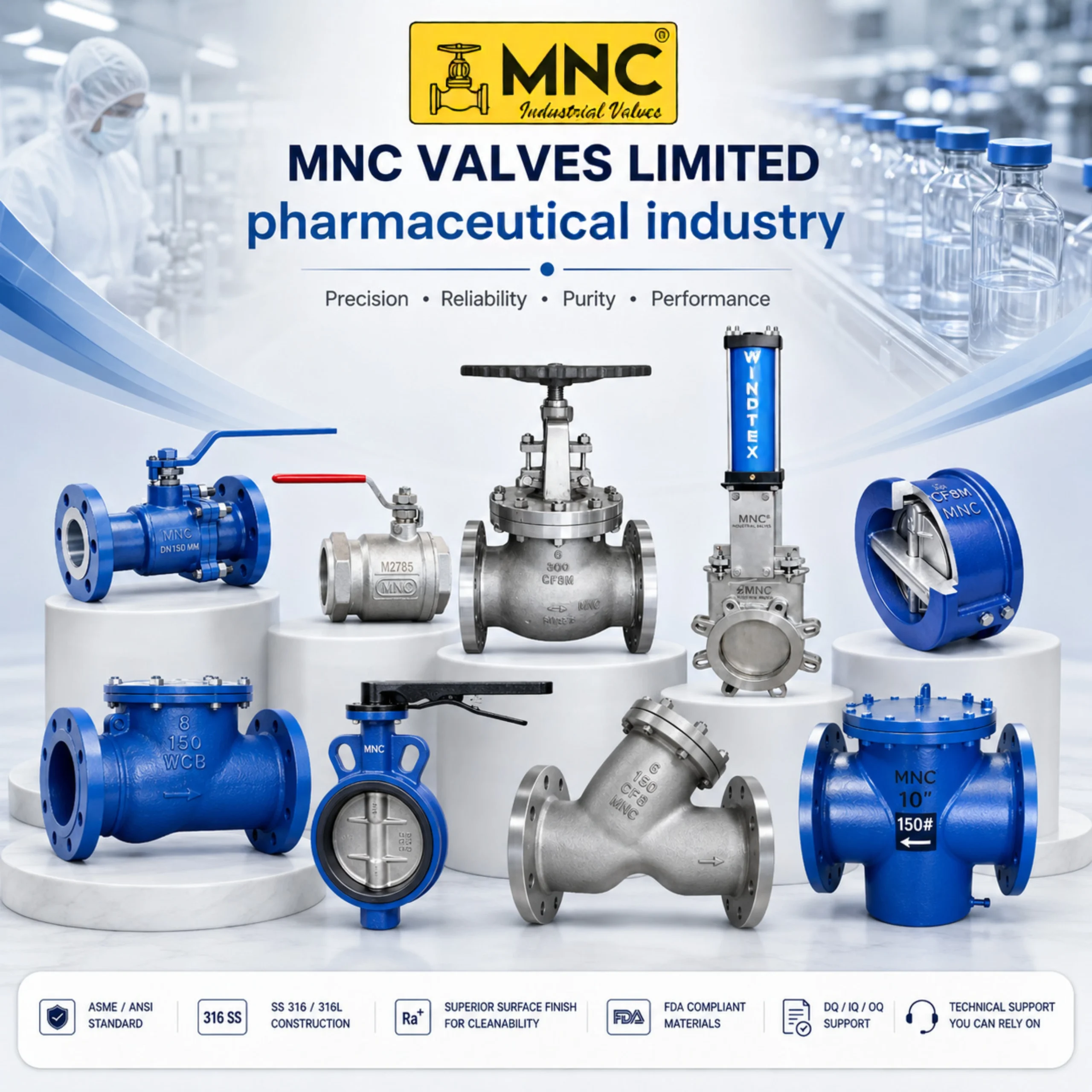
Pharmaceutical manufacturing requires reliable, clean, and process-compatible valve solutions for critical applications where contamination control, cleanability, sealing reliability, and process integrity are essential.
Pharma plants involve purified water systems, clean utility lines, CIP / SIP systems, sterile process lines, chemical dosing, reactor systems, filtration systems, clean steam applications, and automated process control.
Industrial valves used in pharmaceutical applications directly influence product quality, contamination control, process safety, cleaning efficiency, leakage prevention, operational reliability, validation confidence, and maintenance control.
Pharmaceutical plants use valves across multiple critical and utility systems. Each area requires different valve selection logic depending on media type, hygiene requirement, operating pressure, temperature, cleaning method, sealing requirement, automation level, and validation expectation.
Valves support generation and distribution of purified water across clean utility networks.
Clean steam service requires suitable material, sealing, pressure, and temperature compatibility.
Cleaning and sterilization lines require valves compatible with chemicals, hot water, and steam cycles.
Process transfer systems require clean operation, reliable shut-off, and material compatibility.
Reactor lines require valves for feed control, discharge, utility connection, and process isolation.
Automated valves support repeatable operation, batch process control, and remote operation.
Pharmaceutical applications require higher attention to cleanliness and process safety compared to general industrial applications. In pharma applications, a valve must not only control flow. It must support process hygiene, cleaning effectiveness, and operational reliability.
Pharmaceutical systems may involve purified water, clean steam, solvents, process chemicals, sterile fluids, cleaning chemicals, high-temperature cleaning cycles, and frequent operation.
Incorrect valve design or unsuitable internal surfaces can increase contamination risk and cleaning difficulty.
Wrong material selection may cause corrosion, contamination, product loss, or early failure.
Seat and seal materials must match media, temperature, cleaning chemicals, and operating conditions.
Batch process applications may require repeated operation and suitable automation support.
CIP and SIP systems require compatibility with cleaning chemicals, hot water, and steam.
Testing, inspection, documentation, and material awareness support project confidence.
Different pharmaceutical applications require different valve technologies according to media type, cleaning requirement, pressure, temperature, sealing expectation, hygiene requirement, and automation level.
Purified water systems require corrosion-resistant and clean-service compatible valves.
Clean steam systems operate at elevated temperatures and require suitable material and sealing compatibility.
CIP and SIP systems require valves that can tolerate cleaning chemicals, hot water, steam, and frequent operation.
Chemical dosing requires accurate shut-off and chemical-compatible materials.
Reactor systems require valves for feed control, isolation, discharge, utility connection, and process control.
Pharma utility systems include water, compressed air, steam, cooling water, and general plant services.
Material selection is critical for pharma process reliability. Body material, seat material, sealing arrangement, corrosion resistance, and clean process suitability must be reviewed according to actual operating conditions.
| Material | Typical Application |
|---|---|
| SS304 / CF8 | General clean utility and mild process service |
| SS316 / CF8M | Better corrosion resistance for pharma process lines |
| SS316L | Clean, hygienic, and low-carbon stainless steel applications |
| WCB | Utility service where corrosion risk is low |
| PTFE / PFA Lined | Corrosive chemical or aggressive dosing applications |
| Seat / Seal Material | Typical Use |
|---|---|
| PTFE | Chemical resistance and clean process applications |
| RPTFE | Improved strength with chemical resistance |
| EPDM | Water and selected clean utility service |
| Viton | Solvents and selected chemical compatibility |
| PFA / PTFE Lining | Aggressive chemical service |
Modern pharmaceutical plants increasingly use automated valves for better process control, repeatability, batch consistency, remote operation, and reduced manual intervention.
Used where fast and frequent operation is required in clean utility, CIP / SIP, dosing, and batch process applications.
Used where controlled remote operation, panel integration, and command-based movement are required.
Used where flow, pressure, temperature, or dosing must be regulated continuously and accurately.
Pharmaceutical applications often require greater confidence in valve quality, testing, inspection, documentation, and material awareness. Testing and inspection should be aligned with valve type, application, pressure class, and project requirements.
Incorrect valve selection can increase contamination risk, create cleaning difficulty, reduce sealing reliability, and affect process stability.
Valves that are difficult to clean can increase contamination risk and create process hygiene concerns.
Incorrect material may cause corrosion, contamination, leakage, or early failure.
Seat and seal materials must match media, temperature, cleaning chemicals, and operating conditions.
Frequent process operation may require pneumatic or electric actuation for better repeatability.
Poor valve selection may create fluid retention zones and cleaning challenges.
Isolation valves should not be used where accurate process control is required.
Pharmaceutical plants use different valve types according to process function, cleanability requirement, material suitability, and operational control needs.
| Application | Common Valve Type |
|---|---|
| Purified Water Distribution | Ball Valve / Butterfly Valve |
| Clean Steam | Globe Valve / Ball Valve |
| CIP / SIP Systems | Ball Valve / Butterfly Valve |
| Chemical Dosing | Ball Valve / Control Valve |
| Reactor Feed Lines | Ball Valve / Control Valve |
| Pump Protection | Check Valve |
| Utility Lines | Butterfly Valve / Gate Valve |
| Corrosive Chemical Service | PTFE / PFA Lined Valve |
MNC Valves Limited supports pharmaceutical process applications with practical and application-oriented valve selection for clean utility systems, chemical dosing, process isolation, automation, and corrosion-resistant services.
SS304, SS316, and SS316L material options support pharma utility and process applications according to requirement.
PTFE, RPTFE, EPDM, Viton, and lined options are reviewed according to media and service conditions.
Valve selection is aligned with purified water, clean steam, CIP / SIP, and utility process requirements.
Pneumatic, electric, and control valve options support repeatable pharmaceutical process operation.
Testing, inspection, documentation, and material traceability awareness support project confidence.
Valve recommendations are based on actual media, pressure, temperature, cleaning, and process requirements.
If you require valves for pharmaceutical process applications, MNC Valves Limited can support selection of valve type, body material, seat material, pressure class, actuation option, lining compatibility, clean utility suitability, and chemical compatibility.
Please share your BOQ, P&ID, media details, pressure, temperature, cleaning process, automation requirement, and project specifications for technical guidance and quotation support.
Valve recommendations on this page are provided as general engineering guidance for pharmaceutical and clean process applications.
Final valve selection should always be verified according to process conditions, hygiene requirements, media compatibility, cleaning method, operating pressure, temperature, engineering specifications, and customer standards.
Correct engineering evaluation is essential for reliable pharmaceutical process operation.