
MNC Valves Limited offers high-performance Swing Check Valves designed for automatic reverse flow prevention in industrial piping systems. Swing Check Valves are widely used in water systems, pump discharge lines, utility services, chemical plants, process industries, and general industrial applications where reliable one-way flow protection is required.
Automatic reverse flow prevention using a hinged disc design
Suitable for pump discharge, water lines, utility service, and process systems
Low-pressure drop design with full-flow passage logic
Available for domestic and export-oriented industrial projects
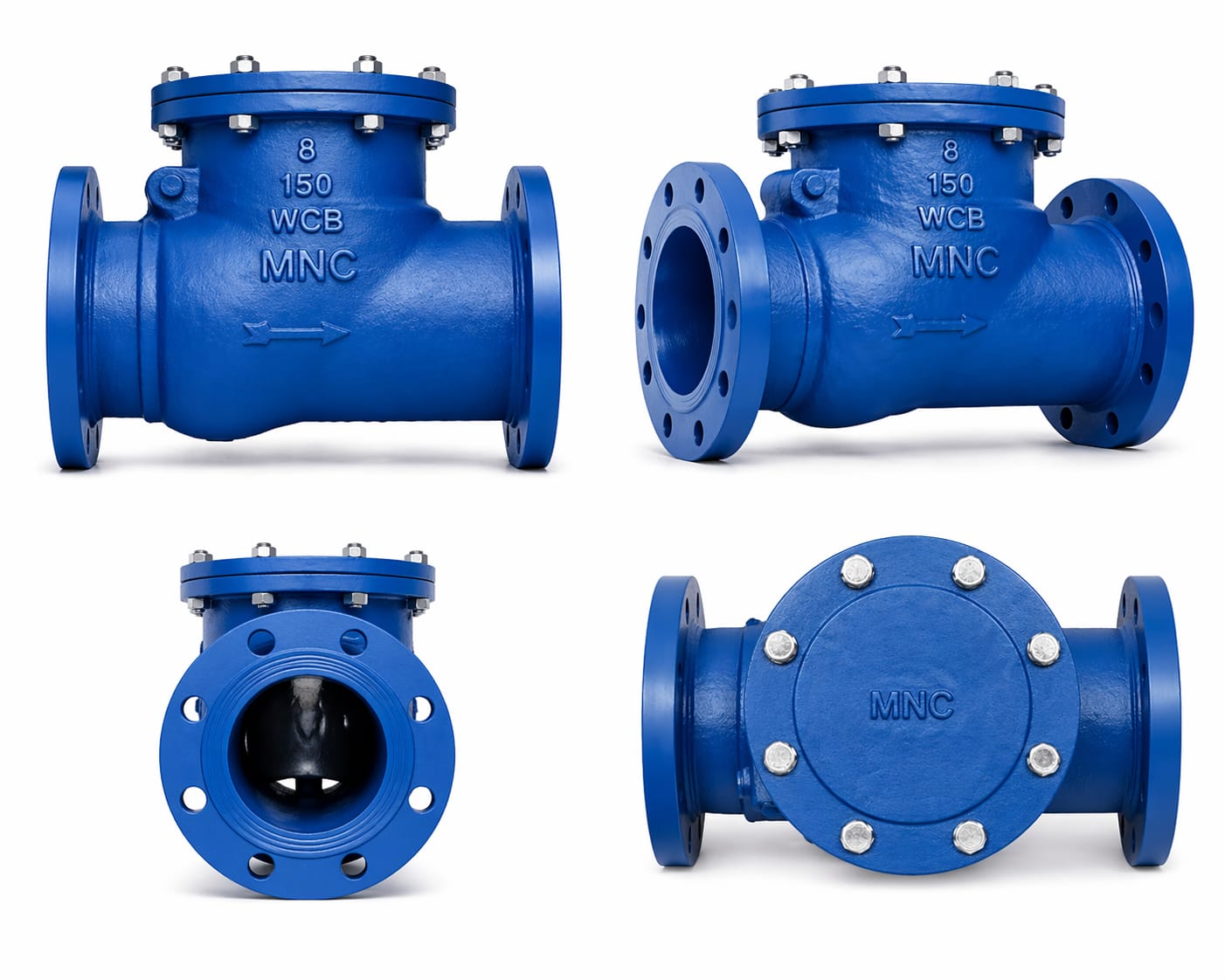
A Swing Check Valve is a type of Non Return Valve in which a hinged disc swings away from the valve seat when forward flow occurs and returns to the seat automatically when the flow stops or reverses. This simple and effective operating principle makes it one of the most widely used check valve designs in industrial piping systems.
Swing Check Valves are preferred in many applications because they offer a relatively low-pressure drop, straightforward internal design, and reliable performance in clean and general utility service. They are especially common in water pipelines, pump discharge lines, and general industrial flow systems.
In industrial systems, reverse flow can damage pumps, disturb line pressure, contaminate upstream equipment, and reduce process reliability. A Swing Check Valve automatically prevents this reverse flow without requiring manual intervention. It is often selected where a conventional, reliable, and economical non return solution is required.
Prevents flow reversal automatically and helps maintain one-direction system logic.
Used in pump discharge systems to help reduce reverse flow risk and equipment damage.
A conventional hinged-disc mechanism offers dependable industrial performance.
When the upstream flow pressure is sufficient, the disc swings away from the seat, creating a flow path through the valve body and allowing fluid to pass.
When the flow slows, stops, or reverses, the disc swings back toward the seat and closes automatically, preventing backflow in the line.
Often preferred where relatively lower flow resistance is desired in the system.
A widely recognized and accepted check valve type for many industrial duties.
Useful for water, utilities, and general pipeline systems where automatic backflow prevention is required.
Used in process water lines, utility systems, and selected pump discharge applications.
One of the most common applications where reverse flow protection is critical.
Suitable for general-purpose industrial utility flow systems.
Applicable where one-way flow control is needed in industrial piping arrangements.
Used in selected utility and process systems to protect line direction and equipment.
Particularly suitable where fluid cleanliness supports conventional hinged-disc operation.
Swing Check Valve
Automatic reverse flow prevention / one-way flow control
Hinged disc opening on forward flow and closing on reverse flow
WCB / CF8 / CF8M / application-specific construction
SS / corrosion-resistant / application-based material selection
Flanged / threaded / application-specific design
Horizontal or vertical, subject to valve design and project requirement
Water / utility fluids / general process fluids / industrial media
Pump discharge / water systems / utility service / process pipelines
Automatic, non-manual
Disc Mechanism
Single hinged disc
Dual spring-loaded plates
Flow Passage
Conventional full-flow style passage
More compact internal arrangement
Valve Length
Generally longer body design
Compact wafer-style face-to-face
Weight
Generally heavier
Generally lighter
Typical Preference
General industrial and water service
Compact piping systems and weight-sensitive installations
For export and industrial projects, Swing Check Valves can be reviewed against applicable customer specifications, line class requirements, connection standards, pressure class requirements, and relevant international standards such as API, ASME, and EN requirements where applicable to the project scope.
Useful for EPCs and consultants who need a conventional non-return valve option for general process and utility duty.
Suitable for equipment builders and industrial skid systems requiring dependable one-way flow protection.
Helpful where site teams and plant owners require a practical and widely understood check valve design.
Contact MNC Valves Limited for application-based support, size and material guidance, and quotation for your Swing Check Valve requirement.
Type selection guidanc
Material and service review
Pump protection application support
Industrial and export-oriented quotation support
MNC Valve Limited Popular Products
Ball Valve
Butterfly Valve & Gate Valve
Strainers Valve
Non Return Valve
Control Valve
Other Valve
A Swing Check Valve is a non return valve that uses a hinged disc to allow forward flow and prevent reverse flow automatically.
It is commonly used in water systems, pump discharge lines, utility services, and general industrial process pipelines.
It is often chosen for its conventional design, relatively low-pressure drop, and wide industrial acceptance.
Yes. Pump discharge protection is one of the most common and important applications of a Swing Check Valve.
Swing Check Valve uses a hinged disc and generally has a larger body profile, while Dual Plate Check Valve uses two spring-loaded plates in a more compact wafer design.
Yes, provided body and trim materials are selected according to the actual chemical media and operating conditions.
No. It operates automatically according to the flow condition in the line.
Some designs can be used vertically, but installation orientation depends on valve design and actual service conditions.
Media type, installation direction, line size, pressure condition, cracking pressure, and project requirement should all be reviewed.
MNC Valves Limited provides application-based support, project-oriented guidance, and export-compatible industrial valve solutions.
WhatsApp us