
MNC Valves Ltd.
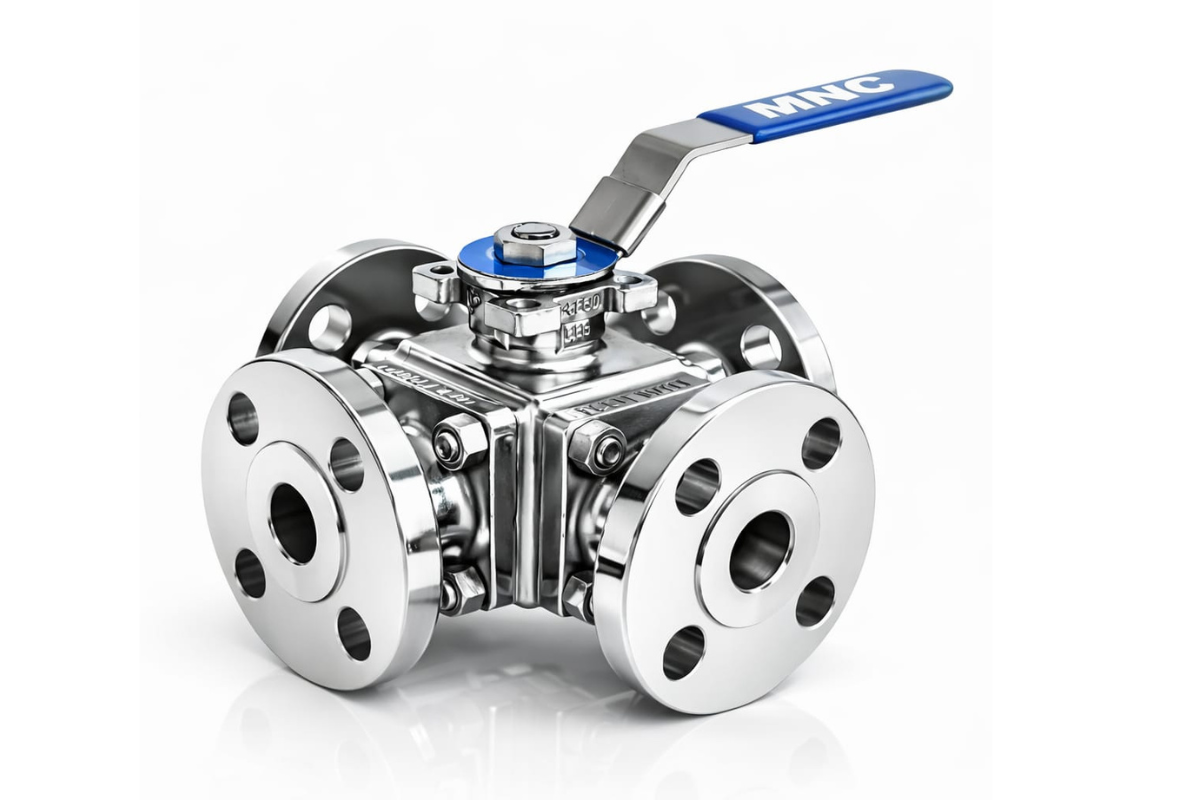
MNC Valves Limited offers 4 way flanged ball valves designed for multi-directional flow diversion, line changeover, transfer duty, and bypass routing in industrial systems where multiple process lines must be controlled through a single compact valve body.
4-port multi-directional flow control through one valve body
Useful for diversion, transfer, bypass, and changeover systems
Flanged end design for secure industrial pipeline installation
Reduces piping complexity and valve count in engineered systems
Many process systems require one stream to be redirected between multiple lines, or one line to be switched between different destinations. If this is done using multiple separate valves and fittings, the system becomes bulkier, more expensive, harder to operate, and more difficult to maintain.
4 way flanged ball valves simplify this process. They bring multi-line routing into one compact valve body and help engineers reduce piping complexity while improving operational clarity.
Used where the process fluid must be redirected between multiple lines from a single valve station.
Can reduce the number of separate isolation valves, tees, and manual switching points.
Useful where the system needs faster and clearer line changeover through one valve assembly.
A 4 way flanged ball valve is a multi-port ball valve with four connected ports and a specially engineered internal ball flow path. By rotating the ball, the valve changes the internal connection between ports and redirects the flow according to the required process routing logic.
It is used in applications where the system needs flow diversion, transfer between lines, bypass operation, or process changeover without relying on multiple separate valves.
The valve uses a specially drilled or engineered ball configuration that connects selected ports depending on the position of the ball during rotation.
As the ball rotates, the flow is redirected from one line to another, or one routing path is closed while another opens, depending on the valve design and process requirement.
Designed to direct the process flow between four connected ports through one engineered valve body.
Useful where one line must be switched to another, or where flow transfer between multiple paths is required.
The internal ball flow routing is selected according to actual process duty, switching positions, and installation logic.
Allows multiple process lines to be managed through a single multiport valve body.
Can replace several individual valves in selected routing and diversion applications.
Helps simplify the piping arrangement where installation space is limited.
Improves operational convenience where line switching must be performed quickly and clearly.
Flanged ends provide a reliable connection standard for industrial pipeline systems.
Can be supplied with pneumatic or electric actuation for automated changeover applications.
Used where media must be redirected from one flow path to another.
Applicable where one process stream must be bypassed or switched into service.
Suitable for systems where one valve must handle controlled routing between several connected lines.
Used where compact routing logic improves plant piping efficiency and operating clarity.
Useful for switching between running and standby lines in utility service applications.
Applied where a project requires application-specific multiport valve routing logic.
4 Way Flanged Ball Valve
Flow diversion / line changeover / bypass routing / multiport transfer duty
4-port / multiport / application-specific internal flow routing design
Flanged ends
WCB / CF8 / CF8M / application-specific construction
SS / corrosion-resistant / application-specific trim
PTFE / RPTFE / application-specific seating arrangement
Water / oil / chemicals / process fluids / utility media
API 598
Industrial routing systems / diversion lines / multi-stream changeover / bypass duty
Main Use
Multi-line diversion and changeoverMulti-line diversion and changeover
Simple one-line on-off isolation
Number of Ports
Four
Two
Flow Logic
Directional switching between multiple paths
Open or close one flow path
System Simplification
System Simplification
Can reduce overall valve count in routing systems
Typical Buyer Preference
Engineered process routing applications
Standard isolation duty
Industrial understanding built through long market and application exposure.
Suitable recommendations for materials, designs, port geometry, and operation modes based on real service conditions.
Structured production and testing approach for dependable industrial performance.
Contact MNC Valves Limited for technical selection support, internal routing guidance, and quotation for your 4 way flanged ball valve requirement.
Multiport selection support
Routing logic guidance
Project-ready quotation
Industrial process application support
MNC Valve Limited Popular Products
Ball Valve
Butterfly Valve & Gate Valve
Strainers Valve
Non Return Valve
Control Valve
Other Valve
A 4 way flanged ball valve is a multiport ball valve used to control and redirect flow between four connected ports.
Its main use is flow diversion, line changeover, bypass routing, and transfer between multiple process lines.
It can simplify piping, reduce valve count, and make process switching more compact and easier to operate.
No. A 4 way ball valve uses specially engineered multiport internal flow routing based on the actual required diversion or changeover duty.
They are used in industrial process plants, diversion lines, utility switching systems, and engineered routing applications.
Yes, they can be supplied with pneumatic or electric actuation depending on process requirements.
Yes, provided the body, trim, and seat materials are selected according to the chemical media and service condition.
Because the internal routing design determines how the process fluid will move between the four connected ports in each valve position.
Flow routing logic, pressure, temperature, media compatibility, required valve positions, and actuation need should all be reviewed before final selection.
MNC Valves Limited provides application-based support, multiport routing guidance, and project-oriented solutions for industrial flow diversion requirements.
WhatsApp us