
MNC Valves Limited offers high-performance Disc Check Valves designed for compact installation, automatic reverse flow prevention, and efficient one-way flow control in industrial piping systems. Disc Check Valves are widely used in water treatment, utility systems, process piping, HVAC lines, compact skids, and industrial applications where reduced size, simple construction, and dependable non-return function are important.
Compact wafer-style construction for space-saving installation
Dual spring-loaded plates for automatic reverse flow prevention
Lower weight compared to conventional flanged check valves
Suitable for domestic and export-oriented industrial projects
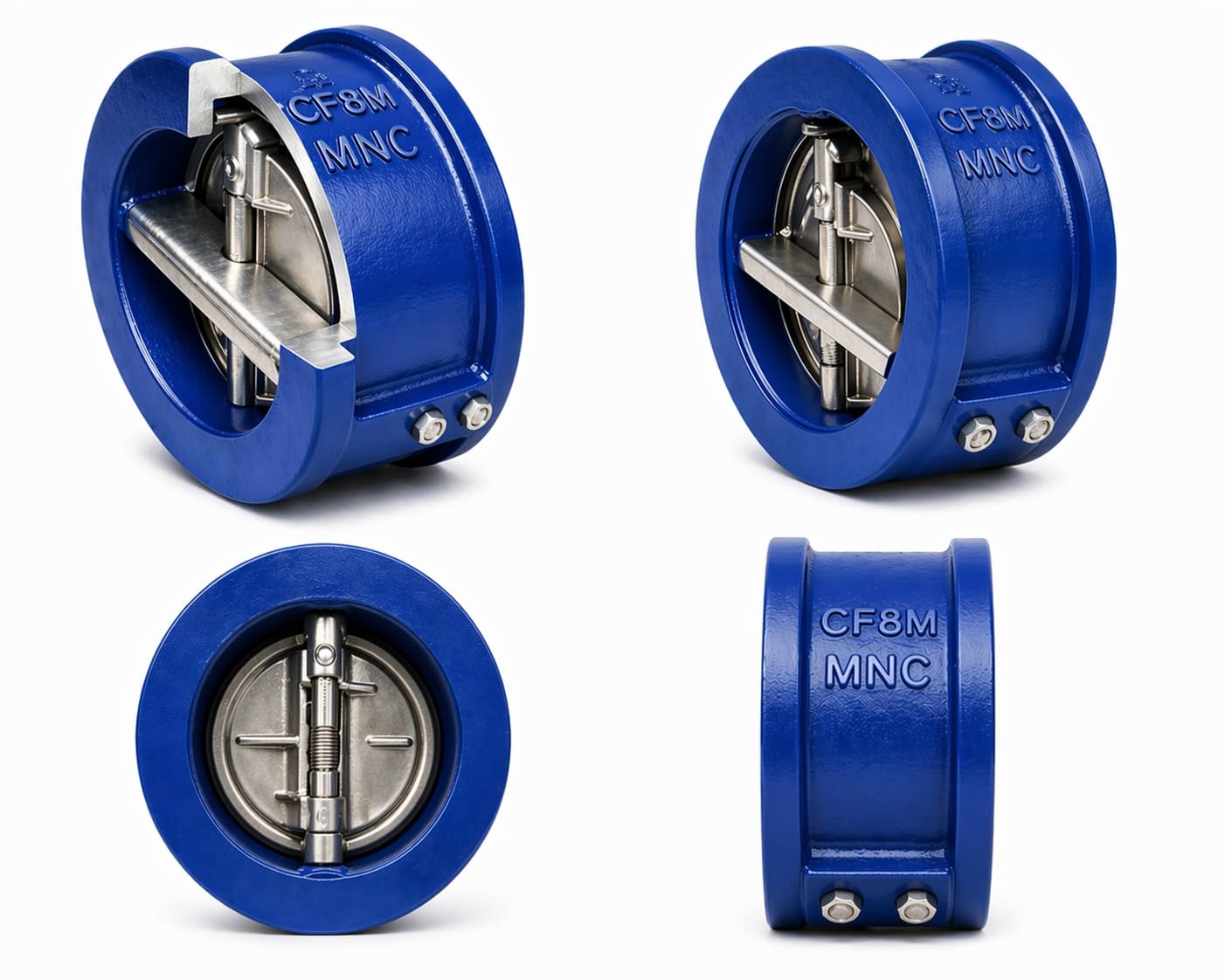
A Dual Plate Check Valve is a compact non return valve that uses two spring-loaded half plates mounted on a central hinge pin. During forward flow, the two plates open inward and allow fluid to pass through the valve. When flow stops or reverses, the spring-assisted plates close quickly and seal against backflow.
Because of its compact wafer-style design, lower weight, and fast closing response, the Dual Plate Check Valve is widely used in applications where installation space is limited and improved reverse flow control is required compared with larger conventional check valve designs.
A Dual Plate Check Valve is a compact non return valve that uses two spring-loaded half plates mounted on a central hinge pin. During forward flow, the two plates open inward and allow fluid to pass through the valve. When flow stops or reverses, the spring-assisted plates close quickly and seal against backflow.
Because of its compact wafer-style design, lower weight, and fast closing response, the Dual Plate Check Valve is widely used in applications where installation space is limited and improved reverse flow control is required compared with larger conventional check valve designs.
Wafer-style body design helps reduce face-to-face length and installation space.
Spring-loaded plates help close the valve more quickly when flow drops or reverses.
Typically lighter than many conventional check valve designs of similar size.
During forward flow, the two half plates move inward against spring tension, opening a flow path through the valve body and allowing fluid to pass.
When flow drops or reverses, the springs assist the plates in returning quickly to the closed position, helping reduce reverse flow and improve line protection.
Compact body profile helps where installation space is limited.
The spring-loaded mechanism helps improve closing speed under changing flow conditions.
Typically lighter than larger conventional check valve designs, making it suitable for many wafer installations.
Used in compact plant layouts, process water systems, and selected pump discharge lines.
Useful where compactness and faster reverse flow response are important.
Suitable for compact pipeline systems requiring automatic one-way flow protection.
Used where wafer-style compact design provides installation advantage.
Selected in applications where reduced weight and wafer installation are preferred.
Suitable where one-way flow control is required within a compact piping arrangement.
Dual Plate Check Valve
Automatic reverse flow prevention / one-way flow control
Dual spring-loaded plates opening on forward flow and closing on reverse flow
Compact wafer-style body
WCB / CF8 / CF8M / application-specific construction
SS / corrosion-resistant / application-based material selection
Wafer type
As per design suitability and project requirements
Water / utility fluids / process fluids / industrial media
Compact pipeline systems / pump discharge / utility and process service
Body Style
Compact wafer design
Conventional larger body design
Closure Element
Two spring-loaded half plates
Single hinged disc
Weight
Generally lighter
Generally heavier
Face-to-Face Length
Shorter
Longer
Typical Preference
Compact installations and faster-closing logic
Conventional general industrial service
In many markets, a Dual Plate Check Valve is also described as a type of Wafer Check Valve because it is commonly manufactured in wafer form. However, in commercial practice and website categorization, both terms are often shown separately because buyers search for them differently and the emphasis of selection may vary by application.
Suitable for EPCs and consultants requiring compact check valve solutions for engineered systems.
Useful where compact size, lower weight, and wafer installation are important for packaged systems.
For export and industrial projects, Dual Plate Check Valves can be reviewed against applicable customer specifications, pressure class requirements, connection standards, line class requirements, and relevant international standards such as API, ASME, and EN requirements where applicable to the project scope.
Contact MNC Valves Limited for application-based support, compact valve selection guidance, and quotation for your Dual Plate Check Valve requirement.
Compact installation support
Wafer mounting support
Pump discharge support
Project quotation support
MNC Valve Limited Popular Products
Ball Valve
Butterfly Valve & Gate Valve
Strainers Valve
Non Return Valve
Control Valve
Other Valve
A Dual Plate Check Valve is a non return valve that uses two spring-loaded plates to allow forward flow and prevent reverse flow automatically.
It is often chosen for its compact wafer design, lower weight, and faster closing response compared to many conventional check valve types.
It is commonly used in water treatment systems, pump discharge lines, HVAC systems, utility pipelines, and compact industrial process installations.
Yes, in many cases it is treated as a type of wafer check valve because of its wafer-style body design, although both are often shown separately in commercial categorization.
The main advantages are compact size, lower weight, and generally quicker closing response.
Yes, it is commonly used in pump discharge systems where automatic reverse flow prevention is required.
No. It operates automatically according to the flow condition in the line.
Yes, provided body and trim materials are selected according to the actual chemical media and operating conditions.
Common materials include WCB, CF8, CF8M, and other application-specific materials depending on service conditions.
Cracking pressure is the minimum pressure required to open the spring-loaded plates and allow forward flow.
Yes, as with any check valve, pressure drop exists and should be reviewed based on size, flow rate, and operating condition.
Yes, they can be designed for higher pressure applications depending on material, design, and project requirements.
Incorrect installation can affect valve operation and may result in improper closure, vibration, or reduced performance.
It can be used in certain vertical installations depending on design suitability and service conditions, but project evaluation is important.
They are generally more suitable for clean or moderately clean service. Application review is needed for dirty service conditions.
Lower weight can simplify installation, reduce structural load, and improve handling in compact piping systems.
Industries include water treatment, HVAC, utility systems, process plants, and general industrial installations.
The valve size should match the pipeline size, but final selection should also consider flow rate, pressure conditions, and system design.
Springs help improve plate return and support quicker closing response when the forward flow drops or reverses.
MNC Valves Limited provides application-based support, project-oriented guidance, and compact export-compatible industrial valve solutions.
WhatsApp us