
MNC Valves Ltd.
MNC Valves Limited manufactures wafer type butterfly valves designed for compact installation, economical pipeline integration, low torque operation, and reliable shut-off across water, utility, HVAC, ETP, chemical, and general industrial applications.
Compact between-flange installation design
Suitable for water, utility, HVAC, and process service
Available in resilient seated and higher performance variants
Manual, gear, pneumatic, and electric operated options
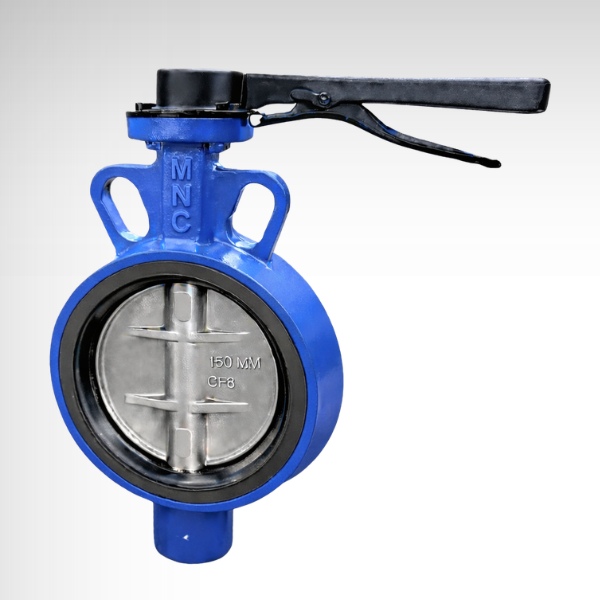
MNC Valves Limited offers wafer type butterfly valves for applications where compactness, reduced weight, and economical installation are important. This design is widely used because the valve body fits between two pipeline flanges, reducing space requirement while still providing effective isolation and control.
Wafer type butterfly valves are especially suitable for water treatment systems, utility pipelines, HVAC service, ETP plants, and general industrial flow handling where practical installation and cost efficiency matter.
A wafer type butterfly valve is a butterfly valve designed to be installed between two mating flanges. The body is compact and aligned using flange bolts, making it one of the most space-efficient butterfly valve constructions.
This design is commonly selected where the buyer wants lower installation weight, simple piping arrangement, and economical shut-off performance in medium and large diameter lines.
The valve body fits between two flanges, reducing installation space and making the valve more compact than many alternative designs.
The disc rotates 90 degrees for opening and closing, providing fast operation and practical flow isolation.
Wafer construction keeps the overall body lighter, which is particularly useful in larger size utility and water lines.
Specification
Wafer Type Butterfly Valve
DN 40 to DN 1200
PN10 / PN16 / PN25 / PN40 depending on design
CI / DI / WCB / CF8 / CF8M
SG Iron / SS304 / SS316
EPDM / NBR / PTFE / Metal depending on duty
SS410 / SS304
Wafer Type
Lever / Gear / Pneumatic / Electric
API / BS / EN as applicable
API 598
Suitability
Excellent
Excellent
Highly suitable
Highly suitable
Lug type may be better
Double flanged may be better
Widely used in water distribution, treatment systems, filtration skids, and utility lines.
Suitable for chilled water and building utility lines where compact installation is important.
Used in treatment plants, recycling systems, and support pipelines for water and wastewater handling.
Applicable with correct material and seat selection in selected chemical utility applications.
Used in process water and treatment-related support systems in textile operations.
Suitable in compact process, utility, and plant support pipelines across multiple industries.
Installation
Between two flanges
Bolted with threaded lugs
Cost
More economical
Higher than wafer type
End-of-line service
Generally limited
Better suited
Maintenance flexibility
Good
Better
Compactness
Excellent
Good
Contact MNC Valves Limited for technical guidance, product selection support, and quotation for your industrial requirement.=
Technical support for selection
Quotation support for project needs
Application-focused product guidance
Business-ready follow-up action
MNC Valve Limited Popular Products
Ball Valve
Butterfly Valve & Gate Valve
Strainers Valve
Non Return Valve
Control Valve
Other Valve
It is a butterfly valve designed to fit between two flanges in a compact and economical installation format.
It is commonly used in water, HVAC, utility, ETP, and general industrial service lines.
The body construction is compact and lighter, which often reduces material and installation cost.
Wafer type fits between flanges, while lug type has threaded lugs and is better for end-of-line service.
Generally lug type is preferred where end-of-line service is required.
EPDM, NBR, PTFE, and metal seats are commonly selected depending on application.
Yes, pneumatic and electric actuated versions can be provided.
Water treatment, HVAC, textile, ETP, utility, and general industrial sectors use them widely.
CI, DI, WCB, CF8, and CF8M are commonly available depending on requirement.
Yes, with proper body, disc, and seat material selection, it can be used in selected chemical applications.
PN10, PN16, PN25, and higher designs may be available depending on construction.
Common causes include wrong seat selection, damaged disc, or improper flange installation.
It can be used for limited throttling depending on design and application conditions.
Improper flange alignment can affect disc movement, sealing, and valve life.
Yes, gear operation is commonly used for larger sizes where lever operation is not practical.
WhatsApp us