
Industrial valve engineering guide for textile processing, dyeing, steam, chemical, utility, and ETP applications. MNC Valves Limited supports textile plants with application-oriented valve solutions for water handling, steam distribution, chemical processing, dyeing operations, wastewater treatment, and sludge handling.
Textile processing plants operate continuously under varying temperature, pressure, chemical exposure, steam conditions, wastewater handling requirements, and automated production systems.
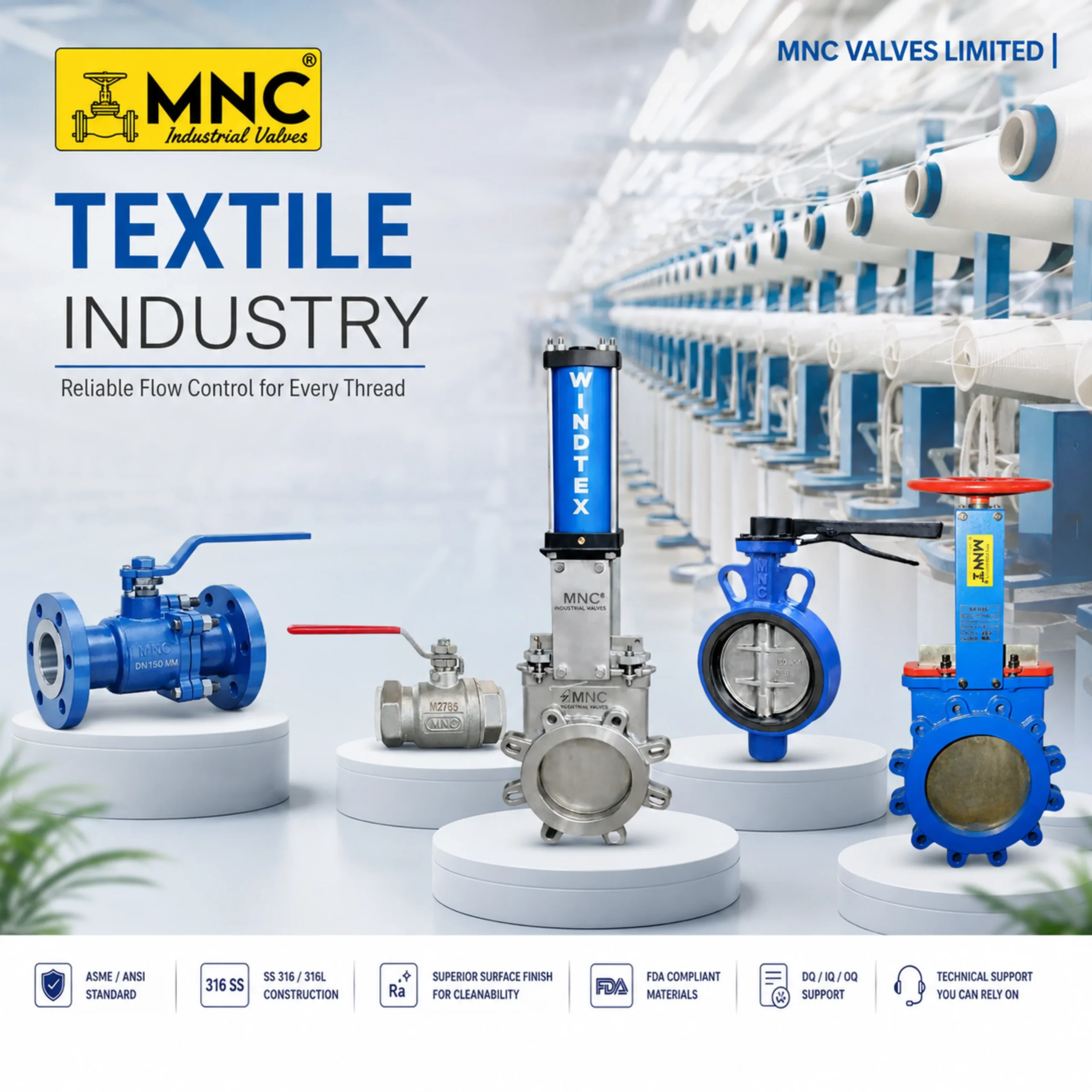
The textile industry depends heavily on reliable industrial valve systems for water handling, steam distribution, chemical processing, dyeing operations, bleaching systems, washing systems, finishing plants, utility services, and wastewater treatment processes.
Industrial valves used in textile plants directly influence process efficiency, dyeing consistency, fabric quality stability, steam control, chemical handling safety, process repeatability, leakage prevention, maintenance reliability, water management, ETP performance, energy efficiency, and operational safety.
For this reason, valve selection in textile industries must be based on chemical compatibility, corrosion resistance, pressure-temperature suitability, steam compatibility, thermal stability, shut-off reliability, automation requirement, continuous-duty suitability, leakage prevention, and maintenance accessibility.
Textile manufacturing involves multiple interconnected process stages where industrial valves perform isolation, flow regulation, steam handling, chemical transfer, pressure control, wastewater management, utility handling, and operational safety functions.
Water is used for washing, bleaching, dyeing, rinsing, cooling, utility systems, and wastewater handling.
Hot water, detergents, alkaline solutions, and cleaning chemicals are used to remove impurities.
Bleaching chemicals and hot process lines require chemical compatibility and leakage prevention.
Dyeing operations require process stability, color consistency, and accurate flow control.
Steam is used for heating, drying, dyeing, washing, calendaring, and temperature control.
Wastewater and sludge systems require corrosion resistance and suitable valve construction.
Water is one of the most critical utilities in textile industries. Textile processing plants consume large quantities of water for washing, bleaching, dyeing, rinsing, cooling, utility systems, and wastewater handling.
Butterfly valves are commonly preferred in large water pipelines due to lightweight construction, economical installation, and easy operation.
Scouring and washing systems remove oils, waxes, dirt, contaminants, and impurities from textile materials before dyeing and finishing operations.
Valve material and seat selection are important due to elevated temperature process conditions and chemical exposure.
Bleaching systems use chemicals such as hydrogen peroxide, caustic solutions, and bleaching agents to improve fabric whiteness, process consistency, and dye absorption capability.
Bleaching systems often involve aggressive chemical exposure requiring suitable corrosion-resistant materials and sealing arrangements.
Dyeing systems are among the most critical areas in textile plants where process consistency directly affects fabric quality, color consistency, and production reliability.
Control valves are commonly used where accurate process regulation and dye dosing consistency are required.
Textile finishing systems involve chemical coating, printing chemicals, softeners, resins, finishing compounds, and process chemicals.
Chemical finishing systems often require PTFE-lined or corrosion-resistant valve configurations due to chemical exposure risk.
Steam systems are widely used in textile plants for heating, drying, dyeing, washing, calendaring, and process temperature control.
Reliable steam control improves thermal efficiency, process consistency, steam utilization, condensate recovery, and energy optimization.
Textile industries generate wastewater containing dyes, chemicals, suspended solids, alkali, acids, bleaching chemicals, and process contaminants.
Knife gate valves are commonly used in sludge handling systems because of their suitability for suspended solids and semi-solid media.
Textile plants involve continuous exposure to dyes, acids, alkali chemicals, bleaching compounds, hot process fluids, and wastewater contaminants.
Incorrect material selection may lead to corrosion damage, leakage, seat failure, operational instability, contamination risk, and maintenance shutdowns.
Valve body and seat materials must match actual textile chemicals and process fluids.
Elevated temperature process fluids require suitable thermal stability and sealing reliability.
Wastewater systems require corrosion-resistant valve construction and operational reliability.
Correct valve selection depends on media type, temperature, chemical exposure, pressure condition, automation requirement, and process criticality.
| Function | Common Valve Type |
|---|---|
| Isolation | Ball Valve / Butterfly Valve |
| Steam Control | Globe Valve |
| Wastewater Handling | Butterfly Valve |
| Sludge Handling | Knife Gate Valve |
| Chemical Service | Lined Ball Valve |
| Backflow Prevention | Check Valve |
Different textile process systems require different valve technologies depending on media, temperature, chemical exposure, valve function, automation requirement, and operational criticality.
| Valve Type | Typical Application | Key Advantages | Limitations |
|---|---|---|---|
| Butterfly Valve | Water & wastewater systems | Lightweight & economical | Limited severe throttling |
| Ball Valve | Chemical & utility systems | Tight sealing & fast operation | Not ideal for heavy throttling |
| Globe Valve | Steam & process control | Accurate throttling | Higher pressure drop |
| Knife Gate Valve | Sludge handling | Suitable for semi-solid media | Limited pressure suitability |
| Check Valve | Pump protection | Prevents reverse flow | No flow regulation |
Material selection is critical due to chemical exposure, hot water systems, steam service, wastewater handling, corrosion risk, and elevated temperature operation.
| Material | Typical Application |
|---|---|
| Cast Iron | Utility water systems |
| Ductile Iron | Water & wastewater systems |
| WCB | General industrial service |
| CF8 | Mild chemical applications |
| CF8M | Corrosive chemical service |
| PTFE / PFA Lined | Aggressive chemical systems |
| Stainless Steel | Dyeing & process systems |
| Seat Material | Typical Application |
|---|---|
| EPDM | Water and selected utility service |
| NBR | Wastewater and selected process service |
| PTFE | Chemical compatibility and corrosive service |
| RPTFE | Chemical resistance with improved mechanical strength |
Material suitability must consider chemical compatibility, steam exposure, temperature condition, corrosion risk, wastewater exposure, and thermal stability.
Modern textile plants increasingly use automated valves for process control, automated dyeing systems, chemical dosing, steam regulation, and operational efficiency.
Used where frequent operation, fast response, and process automation are required.
Used where remote operation, panel integration, and controlled movement are required.
Used where accurate flow, pressure, steam, or chemical dosing control is required.
Incorrect valve selection in textile plants can result in leakage, corrosion, unstable dyeing performance, poor steam control, increased maintenance, and reduced process reliability.
Improper material may fail under chemical exposure or elevated temperature conditions.
Valve body and seat materials must match actual chemicals used in textile processing.
Wastewater sludge systems require suitable valve construction.
Steam systems require pressure-temperature suitable valve materials.
Textile chemicals and wastewater may damage unsuitable valve materials.
Improper sizing may affect process stability, energy efficiency, and production consistency.
Textile processing plants use different valve technologies according to service type, media condition, chemical exposure, temperature, and process control requirement.
| Application | Common Valve Type |
|---|---|
| Water Supply Systems | Butterfly Valve |
| Washing Systems | Ball Valve |
| Bleaching Systems | Lined Ball Valve |
| Dyeing Systems | Ball Valve / Control Valve |
| Steam Heating Systems | Globe Valve |
| Wastewater Systems | Butterfly Valve |
| Sludge Handling | Knife Gate Valve |
| Chemical Dosing | Ball Valve |
MNC Valves Limited supports textile industries with industrial valve solutions designed for water systems, steam systems, dyeing plants, chemical processing, wastewater treatment, sludge handling, and ETP applications.
Valve recommendations are aligned with dyes, acids, alkali chemicals, bleaching compounds, and textile process media.
Material selection is reviewed according to chemical exposure, wastewater condition, and operating temperature.
Steam service applications require pressure-temperature suitability and reliable operation.
ETP and wastewater applications require suitable valve construction and corrosion resistance.
Pneumatic, electric, and control valve options support modern textile process automation.
Valve selection considers continuous operation, maintenance reliability, and production stability.
If you require industrial valves for textile industry applications, MNC Valves Limited can assist in selecting valve type, body material, seat material, chemical compatibility, steam suitability, automation option, wastewater suitability, and sludge handling suitability.
Please share your BOQ, P&ID, operating pressure, operating temperature, media details, chemical details, automation requirement, and project specifications for technical guidance and quotation support.
Valve recommendations on this page are provided as general engineering guidance for textile processing and wastewater treatment applications.
Final valve selection should always be verified according to process conditions, chemical exposure, operating pressure, operating temperature, engineering specifications, customer standards, wastewater characteristics, and safety requirements.
Correct engineering evaluation is essential for reliable textile process operation.