
Hygienic industrial valve solutions for dairy plants, beverage processing, breweries, CIP systems, aseptic applications, sanitary food processing industries, steam utilities, hygienic transfer lines, and food-grade process applications.
Food and beverage plants require hygienic valve solutions focused on product purity, contamination prevention, cleanability, food-grade materials, washdown suitability, thermal cycling resistance, and continuous production reliability.
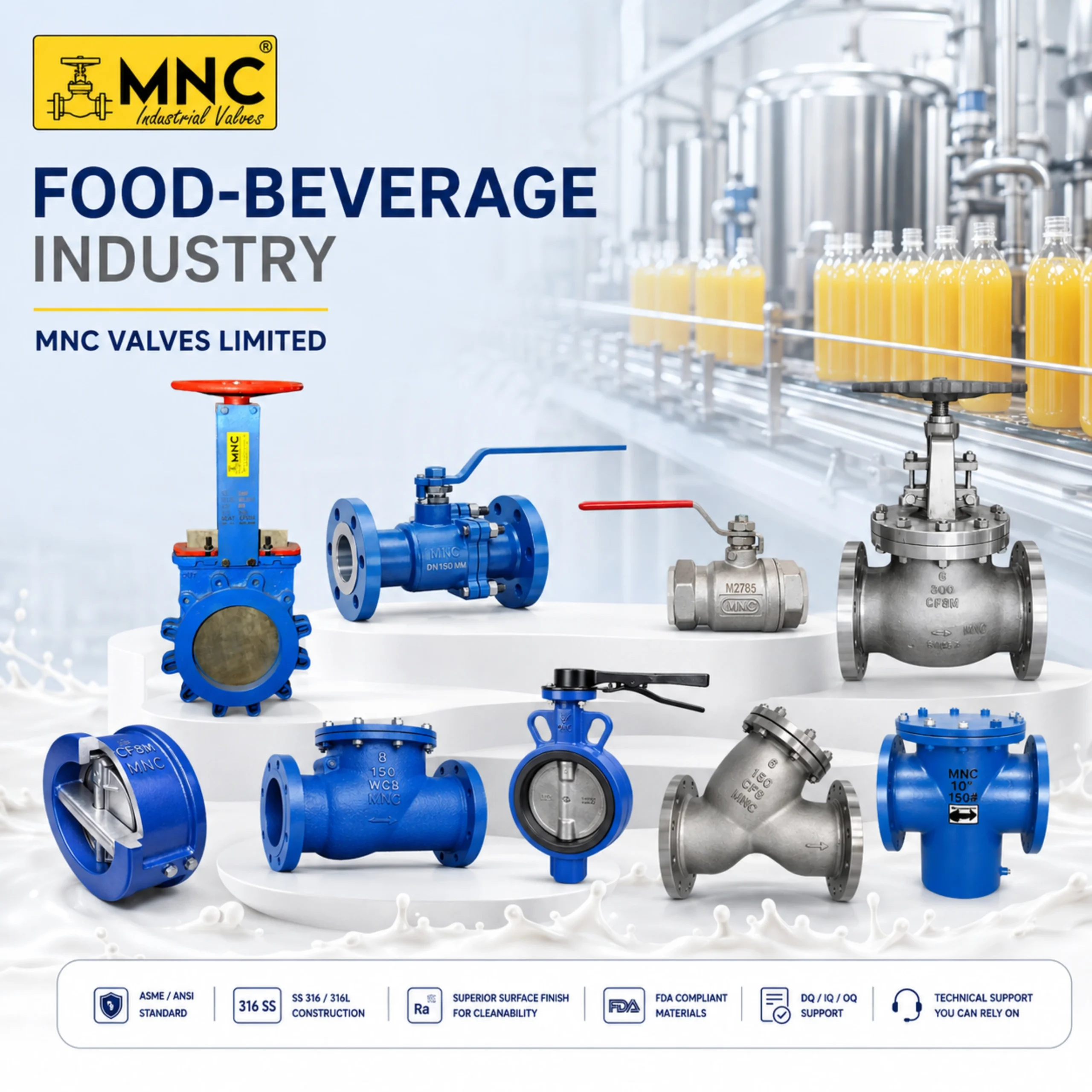
The food and beverage industry operates under highly hygienic and process-sensitive conditions involving sanitary processing systems, contamination prevention requirements, cleanability standards, CIP systems, SIP systems, steam systems, washdown environments, food-grade media handling, thermal cycling conditions, and continuous production operations.
Industrial valves used in food and beverage plants directly influence product purity, hygienic process safety, contamination prevention, cleanability performance, production continuity, process stability, operational efficiency, utility management, cleaning effectiveness, shutdown prevention, maintenance reliability, and food-grade compliance.
For this reason, valve selection in food industries must be based on hygienic suitability, cleanability, contamination prevention, food-grade material suitability, corrosion resistance, sanitary construction, pressure-temperature compatibility, process purity requirements, dead-leg minimization, low dead space design, crevice-free construction, washdown suitability, automation compatibility, continuous-duty reliability, and thermal cycling resistance.
Food and beverage manufacturing involves multiple interconnected hygienic process systems where industrial valves perform isolation, flow regulation, transfer control, utility management, steam handling, CIP circulation, hygienic sampling, and sanitary process control functions.
Milk, cream, yogurt, butter, chilled water, hygienic transfer, and utility systems.
Juice, soft drinks, packaged water, carbonation, filling lines, CO2 systems, and transfer lines.
Fermentation systems, alcohol transfer, steam systems, cleaning systems, and hygienic sampling.
Syrup transfer, edible oil transfer, heated systems, storage tanks, and batch vessels.
Clean-in-place, steam-in-place, cleaning chemicals, thermal cycling, and contamination prevention.
Steam, hot water, chilled water, compressed air, refrigeration, CO2, nitrogen, glycol, and ammonia systems.
Valve selection should always consider product sensitivity, cleaning frequency, temperature cycling conditions, hygienic process requirements, and utility compatibility.
Dairy plants involve highly hygienic processing conditions requiring contamination-free product handling and sanitary process control.
Mixproof valves are highly important in dairy plants because they allow simultaneous product flow and CIP operation while reducing cross-contamination risk.
Check valves are commonly used for pump protection, reverse contamination prevention, and hygienic process stability.
Beverage plants involve continuous hygienic production operations requiring stable flow control and contamination-free process handling.
Pressure vacuum valves are commonly used on beverage tanks and storage vessels for pressure balancing and hygienic tank protection.
Sampling valves are widely used for product testing and quality control applications.
Breweries and distilleries involve fermentation systems, steam systems, utility systems, alcohol transfer systems, and hygienic process applications.
Diaphragm valves are especially important in aseptic and sterile applications because of their crevice-free design, low dead space characteristics, and excellent cleanability.
Sugar and syrup processing systems involve viscous media handling, heated process systems, and hygienic transfer requirements.
Edible oil plants involve transfer systems, heating systems, storage systems, and hygienic utility operations.
Edible oil systems require dependable valve operation for hygienic product handling, temperature compatibility, foodgrade sealing, and contamination prevention.
Mixing and batching systems are critical for product consistency, formulation control, and hygienic process management.
Mixing systems require stable flow regulation, hygienic process control, low dead space, crevice-free construction, and automation compatibility.
Aseptic and sterile processing systems involve highly sensitive hygienic applications where contamination prevention is critically important.
CIP (Clean-In-Place) and SIP (Steam-In-Place) systems are critical for hygienic cleaning and contamination prevention in food industries.
CIP and SIP systems commonly involve repeated hot steam and cold water exposure which may create thermal cycling conditions.
Mixproof valves are highly valuable in CIP systems where simultaneous product handling and cleaning operations are required.
Food industries commonly involve steam systems, chilled water systems, hot water systems, compressed air systems, refrigeration systems, nitrogen systems, ammonia refrigeration systems, and utility applications.
Utility systems require dependable valve operation for stable plant performance, pressure integrity, temperature suitability, corrosion resistance, and utility stability.
Food plants regularly use hygienic sampling systems for quality control, laboratory testing, contamination monitoring, and production verification.
Sampling systems play an important role in maintaining food quality, hygienic production standards, and contamination prevention.
Food and beverage industries involve highly sensitive hygienic process conditions including contamination prevention requirements, cleanability requirements, food-grade compatibility, washdown conditions, corrosive cleaning chemicals, steam cleaning cycles, sanitary transfer requirements, and product purity requirements.
Incorrect valve selection may increase contamination risk and negatively affect hygienic process safety.
Dead-leg areas and excessive dead space may increase bacterial accumulation risk.
Unsuitable valve construction may negatively affect cleaning effectiveness and operational hygiene.
Incorrect materials may create corrosion issues and hygiene risks under food-grade applications.
Improper seat materials may fail under steam cleaning cycles or cleaning chemical exposure.
Valve failures and hygiene issues may result in production losses and operational downtime.
For critical hygienic applications, cavity-filled hygienic ball valves may be preferred to reduce product accumulation risk.
Correct valve selection depends on process media, hygienic requirement, cleaning method, operating condition, and utility requirement.
| Function | Common Valve Type |
|---|---|
| Hygienic Isolation | Hygienic Ball Valve |
| Utility Isolation | Hygienic Butterfly Valve |
| Steam Control | Globe Valve |
| Flow Modulation | Control Valve |
| Ingredient Transfer | SS316 Ball Valve |
| CIP Systems | Mixproof Valve |
| Aseptic Systems | Diaphragm Valve |
| Tank Bottom Draining | Flush Bottom Valve |
| Quality Sampling | Sampling Valve |
Different food and beverage applications require different hygienic valve types depending on media, cleaning method, process sensitivity, pressure-temperature condition, and contamination control requirement.
| Valve Type | Typical Application | Key Advantages | Limitations |
|---|---|---|---|
| Hygienic Ball Valve | Hygienic transfer systems | Tight shut-off & hygienic suitability | Limited throttling |
| Hygienic Butterfly Valve | Utility and hygienic transfer systems | Easy cleaning & economical | Limited precision throttling |
| Globe Valve | Steam systems | Accurate throttling | Higher pressure drop |
| Diaphragm Valve | Aseptic systems | Crevice-free hygienic flow | Higher cost |
| Mixproof Valve | Dairy & CIP systems | Prevents cross contamination | Higher complexity |
| Flush Bottom Valve | Tank bottom applications | Complete draining capability | Specialized application |
| Sampling Valve | Quality control systems | Hygienic product testing | Limited process application |
Material selection is critical due to hygienic process conditions, corrosion exposure, cleaning chemicals, steam cleaning cycles, food-grade requirements, and washdown environments.
| Material | Typical Application |
|---|---|
| SS304 | General food-grade systems |
| SS316 | Corrosive hygienic systems |
| SS316L | High hygienic applications |
| PTFE Lined Components | Chemical cleaning systems |
| FDA Compliant Soft Seats | Hygienic sealing systems |
| Food-Grade Elastomers | Sanitary process systems |
| Seat Material | Typical Practical Usage |
|---|---|
| EPDM | Dairy, hot water, and selected hygienic utility systems |
| PTFE | CIP chemicals, cleaning systems, and chemical compatibility applications |
| RPTFE | Improved mechanical strength with chemical resistance |
| FDA Compliant Elastomers | Food-contact hygienic applications |
Material suitability must consider corrosion resistance, foodgrade compatibility, steam resistance, cleanability, chemical compatibility, hygienic suitability, and thermal cycling resistance.
Polished internal surfaces, smooth wetted surfaces, and proper surface finish are important for contamination prevention and hygienic process safety.
Modern food industries increasingly use automated valves for hygienic process control, batching systems, CIP systems, steam systems, utility management, dairy systems, beverage lines, and sanitary production processes.
Used where frequent operation, fast response, washdown suitability, and automated process control are required.
Used where remote operation, controlled movement, and panelbased operation are required.
Used for flow modulation, batching accuracy, steam control, CIP operation, and sanitary process stability.
Incorrect valve selection in food and beverage plants may affect hygiene, cleanability, product purity, process stability, and production continuity.
Improper materials may create corrosion and hygiene risks.
Unsuitable valve construction may create contamination accumulation areas.
Dead-leg areas may increase bacterial accumulation risk.
Improper seat materials may fail under cleaning chemical exposure or steam cleaning cycles.
Food industries require washdown-compatible valve construction.
Incorrect valve selection may negatively affect product purity and process hygiene.
Food and beverage plants require different valve types according to product sensitivity, cleaning method, process media, hygienic requirement, and utility application.
| Application | Common Valve Type |
|---|---|
| Dairy Systems | Hygienic Butterfly Valve |
| Beverage Systems | Hygienic Ball Valve |
| Steam Systems | Globe Valve |
| CIP Systems | Mixproof Valve |
| Syrup Transfer | SS316 Ball Valve |
| Aseptic Systems | Diaphragm Valve |
| Tank Bottom Applications | Flush Bottom Valve |
| Quality Sampling Systems | Sampling Valve |
| Utility Systems | Hygienic Butterfly Valve |
MNC Valves Limited supports food and beverage industries with industrial valve solutions designed for hygienic systems, sanitary transfer applications, steam systems, utility systems, CIP systems, and food-grade industrial operations.
Valve selection considers contamination prevention, cleanability, low dead space, and hygienic process safety.
Material selection is reviewed according to SS304, SS316, SS316L, food-grade elastomers, and process conditions.
Valve recommendations consider cleaning chemicals, steam cleaning cycles, and thermal cycling conditions.
Hygienic transfer systems require smooth wetted surfaces, proper sealing, and cleanable construction.
Pneumatic and electric actuation options support batching systems, CIP systems, and production automation.
Valve selection is guided by actual media, cleaning frequency, pressure-temperature conditions, and process sensitivity.
If you require industrial valves for food and beverage industry applications, MNC Valves Limited can assist in selecting valve type, body material, seat material, hygienic suitability, CIP compatibility, SIP suitability, automation option, food-grade sealing arrangement, and utility suitability.
Please share your BOQ, P&ID, operating pressure, operating temperature, media details, cleaning requirements, automation requirement, end connection requirement, and project specifications for technical guidance and quotation support.
Valve recommendations on this page are provided as general engineering guidance for food and beverage industry applications.
Final valve selection should always be verified according to hygienic process requirements, operating pressure, operating temperature, cleaning requirements, food-grade standards, engineering specifications, customer standards, media characteristics, and safety requirements.
Correct engineering evaluation is essential for reliable hygienic food processing operations.