
A practical engineering guide for selecting industrial valves according to real operating conditions, pressure systems, temperature exposure, media characteristics, automation requirements, engineering standards, and long-term operating reliability.
Wrong valve selection may eventually cause leakage, cavitation, erosion, unstable operation, excessive maintenance, production downtime, actuator failure, and emergency shutdowns.
Industrial valve selection is one of the most important engineering decisions in any operating system. A valve is not simply an open-and-close product. It directly affects process continuity, shutdown prevention, pressure integrity, operational safety, utility stability, maintenance frequency, energy efficiency, lifecycle cost, sealing reliability, and long-term plant performance.
Many shutdowns begin from small leakage problems that were initially ignored. In many applications, the cost of wrong valve selection becomes far greater than the initial valve cost.
One of the most important engineering considerations is understanding what media will actually flow through the valve. Different media create different engineering challenges for corrosion, erosion, sealing life, cavitation risk, pressure drop, valve material suitability, and operational reliability.
Clean water systems commonly use butterfly valves, ball valves, and gate valves. Pressure drop, corrosion resistance, and sealing performance remain important considerations.
Wastewater service may involve suspended particles, sludge, contamination, and corrosion exposure. Resilient seated butterfly valves and knife gate valves are commonly considered.
Steam creates high-temperature exposure, thermal stress, pressure variation, and sealing challenges. Globe valves, gate valves, and metal seated valves are commonly used.
Slurry service is one of the most demanding operating environments due to abrasion and erosion exposure. Incorrect valve selection may rapidly destroy internal components.
Chemical service requires careful evaluation of corrosion compatibility, sealing materials, temperature exposure, and pressure conditions.
Food applications require hygienic suitability, cleanability, contamination prevention, smooth internal surfaces, and stainless steel compatibility.
Pressure conditions directly affect valve body design, pressure-retaining capability, sealing stability, and operational safety. Improper pressure class selection may eventually result in leakage, deformation, instability, and operating hazards.
Pressure rating should never be selected only according to normal operating pressure. Transient operating conditions are equally important.
Temperature directly affects seat materials, sealing performance, thermal expansion, body integrity, packing performance, and long-term operational reliability.
Cavitation is one of the most damaging conditions in valve engineering. It occurs when pressure drops below vapor pressure and vapor bubbles collapse violently inside the valve.
Flashing is another dangerous condition where liquid permanently converts into vapor. These conditions become especially important in control valves, high-pressure drop systems, steam applications, and chemical systems.
Cavitation resistance should always be considered during valve sizing and valve type selection for demanding operating conditions.
Material selection remains one of the most critical areas in industrial valve engineering. Incorrect material selection may eventually result in corrosion, erosion, leakage, premature wear, maintenance escalation, and reduced service life.
Commonly used for low-pressure utility systems and water applications.
Provides better mechanical strength than cast iron and is widely used in utility and water systems.
Widely used in steam systems, industrial utilities, oil & gas, and demanding operating conditions.
Commonly used for hygienic systems, utility applications, and mild corrosive environments.
Provides better corrosion resistance compared to CF8 and is suitable for more demanding operating environments.
Some severe-service applications require specialized alloys, lining systems, or application-oriented engineered materials.
End connection selection affects installation, maintenance accessibility, alignment, rigidity, and long-term pipeline integrity.
Modern operating systems increasingly use pneumatic actuators, electric actuators, and automated control systems for process automation, remote operation, utility management, and operating stability.
| Parameter | Pneumatic Actuation | Electric Actuation |
|---|---|---|
| Operating Speed | Faster | Slower |
| Automation Capability | Excellent | Excellent |
| Fail-Safe Arrangement | Easier | More Complex |
| Utility Requirement | Air Supply | Electrical Supply |
| Common Applications | Process Industries | Utility & Automation Systems |
Standards help support dimensional consistency, testing discipline, pressure integrity, interchangeability, engineering reliability, and operational confidence.
Valve inspection and testing standard used for pressure testing and leakage verification.
Industrial butterfly valve standard covering design and engineering requirements.
Steel gate valve standard widely used in industrial systems.
Valve testing standard covering inspection and pressure testing requirements.
Actuator mounting standard supporting automation compatibility.
Used for pressure-temperature ratings, dimensions, and piping compatibility.
Standards help improve engineering consistency, interchangeability, testing reliability, and long-term operational confidence.
Different industries create completely different operating challenges. A valve suitable for one industry may not perform reliably in another environment. Proper valve selection should always consider actual process conditions, pressure variation, media characteristics, abrasion exposure, corrosion possibility, maintenance accessibility, and operational continuity requirements.
Water treatment systems require dependable flow control, pressure stability, corrosion resistance, and operational continuity.
Chemical service requires careful material compatibility evaluation and sealing reliability.
Steam systems require thermal stability, pressure integrity, and high-temperature compatibility.
Slurry systems create severe abrasion and erosion challenges for internal valve components.
Food applications require contamination prevention, hygienic suitability, and corrosion resistance.
Cement industries involve abrasive dust, severe-service exposure, and demanding operating conditions.
Many operating failures begin when valves are selected according to catalog similarity instead of actual operating conditions. Real engineering suitability always depends on media, pressure, temperature, operating function, maintenance accessibility, service severity, and long-term operating requirements.
Ball valves and butterfly valves are among the most widely used industrial valves. However, both serve different engineering purposes and operating priorities.
| Parameter | Ball Valve | Butterfly Valve |
|---|---|---|
| Main Function | Isolation Service | Isolation & Moderate Throttling |
| Shut-Off Performance | Excellent | Good |
| Pressure Capability | Higher | Moderate |
| Large Size Economy | Moderate | Better |
| Compactness | Moderate | Excellent |
| Automation Suitability | Excellent | Excellent |
| Operating Torque | Higher | Lower |
| Typical Applications | Oil & Gas, Utilities, Isolation | Water, HVAC, Utility Systems |
Ball valves are often preferred where tight shut-off and higher pressure capability are important, while butterfly valves are commonly selected for compactness, utility systems, and large pipeline economy.
Gate valves and globe valves serve very different engineering purposes. Understanding their operating logic is critically important.
| Parameter | Gate Valve | Globe Valve |
|---|---|---|
| Main Function | Isolation | Throttling & Flow Control |
| Pressure Drop | Lower | Higher |
| Flow Regulation | Poor | Excellent |
| Shut-Off Capability | Excellent | Good |
| Operating Speed | Slower | Moderate |
| Typical Applications | Isolation Duty | Flow Regulation |
One of the biggest mistakes in industry is selecting valves only according to initial purchase price. The lowest-cost valve may not always become the lowest-cost solution over the complete operating life of the system.
Incorrect valve selection may eventually create repeated maintenance, leakage problems, operational instability, replacement cost escalation, shutdown risk, and production losses.
Many plants initially focus only on valve purchase cost. However, over time, repeated failures, maintenance shutdowns, leakage problems, emergency replacement, and production interruption may become significantly more expensive than the original valve investment.
Before selecting any industrial valve, actual operating conditions should always be evaluated carefully. These engineering questions help improve long-term operating reliability and application suitability.
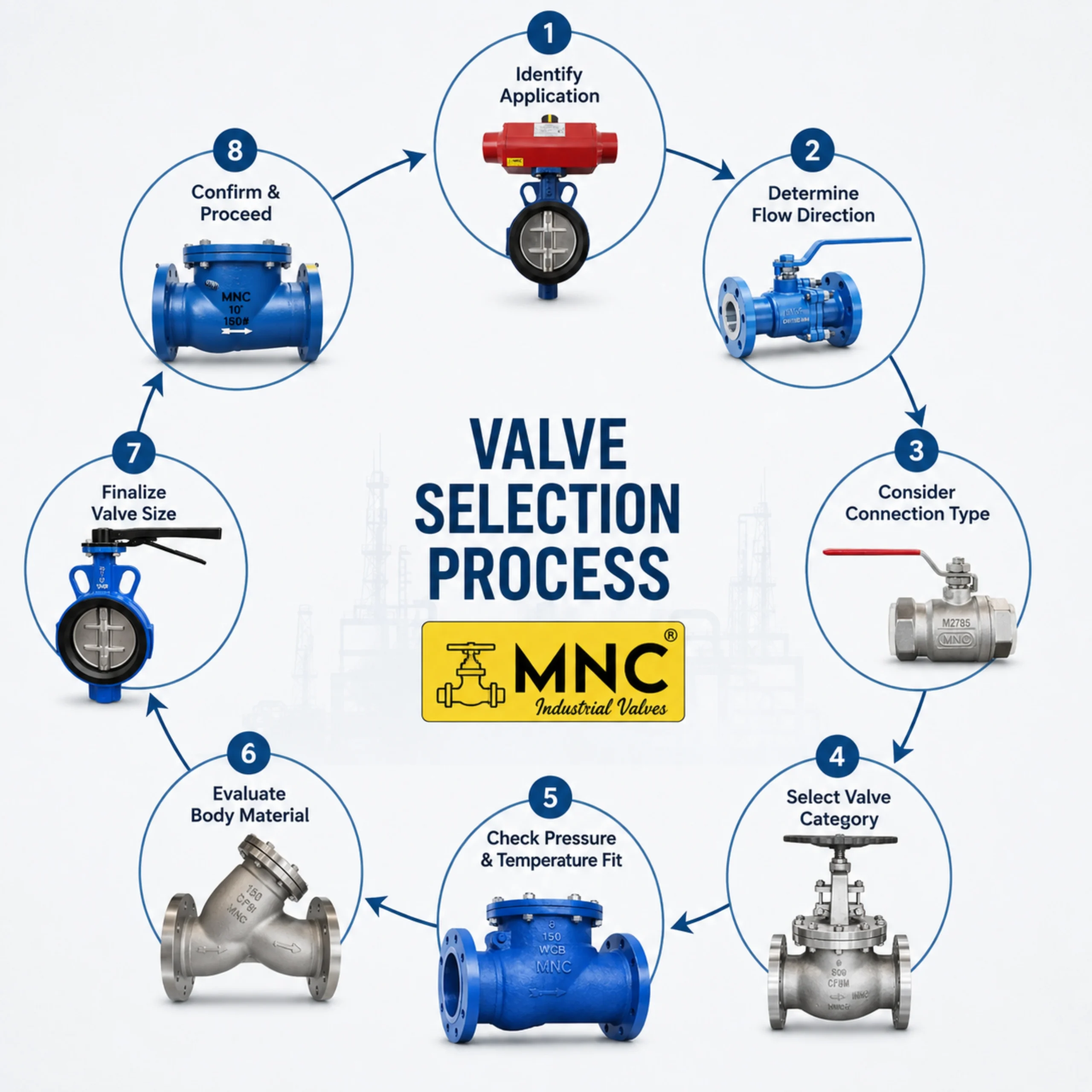
Professional valve selection should always follow a structured engineering approach instead of random product comparison.
Professional valve selection should always be approached from long-term operating reliability perspective — not only initial purchase cost perspective.
MNC Valves Limited focuses on application-oriented engineering, practical operating understanding, technical communication, process suitability, engineering-focused support, and long-term service thinking.
Different operating environments require different engineering solutions, valve designs, materials, seats, and automation systems.
Valve selection is evaluated according to actual operating conditions — not only catalog appearance or general assumptions.
Engineering suitability helps improve process continuity, reduce maintenance frequency, and support long-term operational stability.
If you require assistance for valve selection, material selection, actuator selection, pressure-temperature review, application evaluation, BOQ review, or P&ID discussion, MNC Valves Limited can assist with engineering-oriented valve selection support.
Please share your operating conditions, media details, pressure-temperature requirements, application details, automation requirements, and engineering specifications for technical review and recommendation support.
Valve selection recommendations should always be verified according to actual operating conditions, engineering specifications, pressure-temperature limitations, applicable standards, media characteristics, and safety requirements.
Correct engineering evaluation remains essential for reliable operating performance, service safety, sealing reliability, and long-term system stability.