
Complete industrial valve selection guide for water and wastewater treatment systems. MNC Valves Limited supports water infrastructure projects with application-oriented valve solutions for raw water, filtration, chemical dosing, sludge handling, pump protection, and treated water distribution.
Water treatment plants operate continuously under demanding conditions involving large diameter pipelines, variable pressure, suspended solids, corrosive chemicals, sludge movement, and automated flow control.
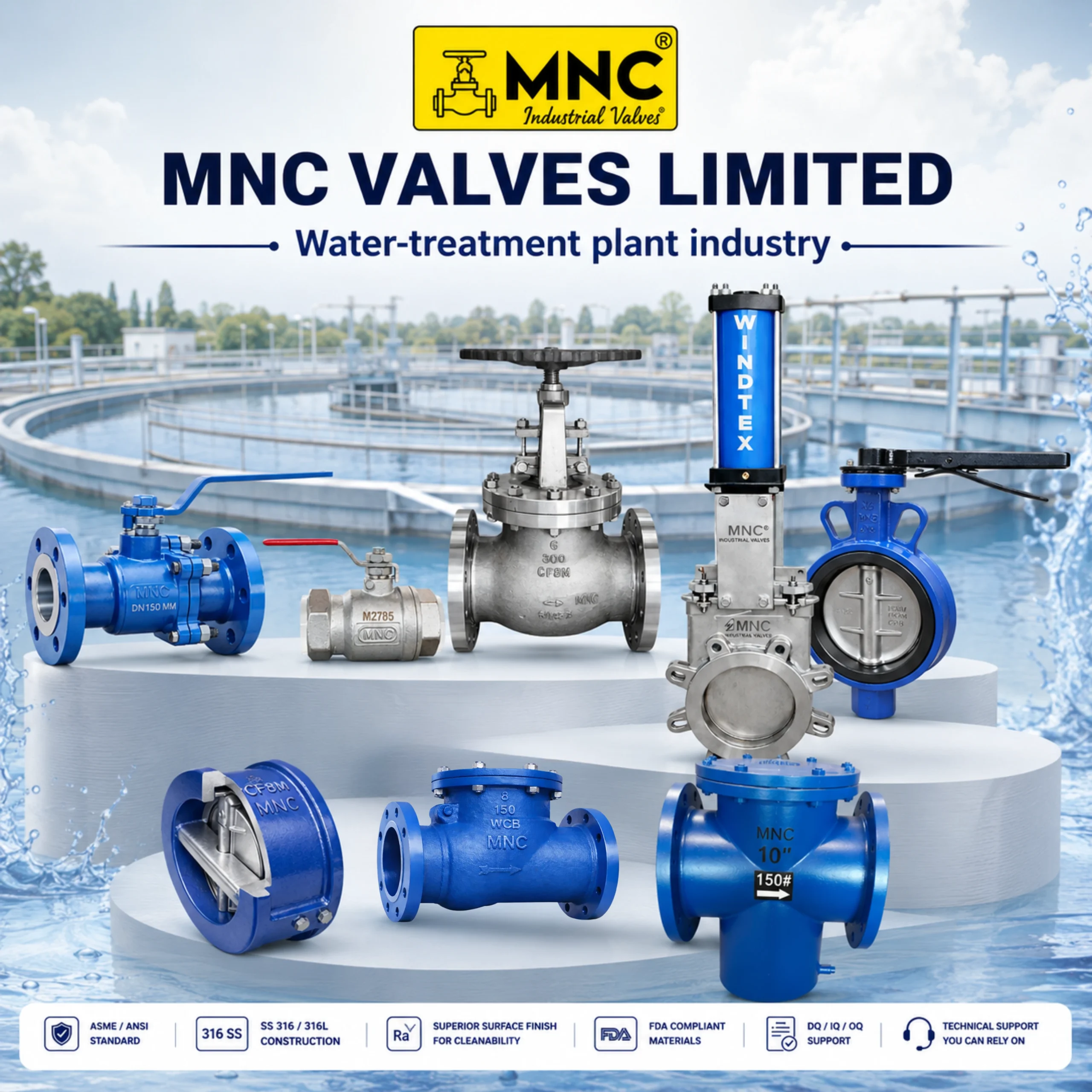
Water treatment plants depend on reliable industrial valves to control, isolate, and regulate the flow of water, chemicals, sludge, and wastewater throughout the treatment process. Proper valve selection is essential for ensuring plant safety, operational efficiency, energy optimization, and long service life of piping systems.
Water infrastructure systems operate continuously and often involve large diameter pipelines, variable pressure conditions, corrosive environments, suspended solids, and chemical dosing systems. For this reason, valves used in water treatment plants must be carefully selected based on process conditions, material compatibility, pressure requirements, automation needs, and applicable engineering standards.
Water treatment plants consist of several process stages where valves are used to control fluid flow, isolate equipment, protect pumps, regulate pressure, prevent reverse flow, manage sludge movement, and support automation systems.
Untreated water enters the plant from rivers, reservoirs, lakes, groundwater, or intake pumping systems.
Chemicals such as chlorine, alum, polymers, and coagulants are introduced into the process.
Suspended particles combine into larger flocs for easier removal during sedimentation.
Settled solids are separated from water and prepared for sludge handling.
Water passes through sand filters, multimedia filters, activated carbon filters, or membrane filtration units.
Sludge, suspended solids, and fibrous media are handled through dedicated pipelines.
Treated water is supplied to storage tanks, municipal networks, or industrial distribution systems.
The raw water intake system transports untreated water from rivers, reservoirs, lakes, or groundwater sources into the treatment facility. These pipelines are typically large in diameter, operate under low to moderate pressures, and handle continuous high-flow service.
| Parameter | Typical Requirement |
|---|---|
| Pipeline Size Range | DN300 – DN2000 |
| Pressure Rating | PN10 / PN16 / Class 150 |
| Body Materials | Ductile Iron / Carbon Steel WCB |
| Seat Materials | EPDM / NBR |
Butterfly valves are widely used in large water transmission pipelines because of their compact design, lower weight, economical installation, and easy automation capability.
Chemical dosing systems introduce treatment chemicals such as chlorine, alum, coagulants, polymers, and pH control chemicals into the process. Valves used in chemical dosing applications must provide tight shut-off performance, corrosion resistance, chemical compatibility, reliable sealing, and operational consistency.
| Parameter | Typical Requirement |
|---|---|
| Body Materials | CF8 Stainless Steel / CF8M Stainless Steel |
| Seat Materials | PTFE / RPTFE |
| Typical Size Range | DN15 – DN100 |
Material compatibility is critical in chemical dosing applications. Valve body, seat, seal, and trim selection must be reviewed according to the actual chemical, concentration, pressure, and temperature.
Filtration systems remove suspended solids and impurities using sand filters, multimedia filters, activated carbon filters, or membrane filtration systems. Valves in filtration systems are used for filter isolation, backwash control, flow distribution, maintenance shutdown, and automation control.
Automation is widely used in filtration systems to improve process control, backwash sequencing, and operational efficiency.
Sludge pipelines carry viscous fluids containing suspended solids, organic matter, fibrous materials, and abrasive waste. These applications require valve technologies capable of handling difficult media conditions.
| Parameter | Typical Requirement |
|---|---|
| Size Range | DN100 – DN600 |
| Pressure Rating | PN10 |
| Gate Material | SS304 / SS316 |
Sludge applications require proper valve selection to reduce clogging, leakage, maintenance frequency, and operational interruption.
After treatment, water is transferred through storage tanks, pumping systems, municipal distribution pipelines, and industrial water supply systems. Valves in treated water systems must provide reliable shut-off, long service life, low maintenance, and operational reliability.
Large diameter butterfly valves are widely used in treated water systems because they provide low installation weight, compact operation, automation compatibility, and economical large diameter control.
Correct valve selection requires a structured engineering approach. A valve should not be selected only by size or availability. Fluid type, pipeline diameter, pressure rating, valve function, and automation requirement must be reviewed together.
Correct valve selection improves reliability, reduces maintenance risk, protects equipment, and supports efficient plant operation.
| Valve Function | Recommended Valve Type |
|---|---|
| Isolation | Gate Valve / Butterfly Valve |
| Flow Control | Globe Valve / Butterfly Valve |
| Backflow Prevention | Check Valve |
| Slurry Service | Knife Gate Valve |
Different valve types serve different purposes in water and wastewater treatment systems. The correct valve should be selected according to function, media, pressure condition, and maintenance requirement.
| Valve Type | Best Application | Key Advantages | Limitations |
|---|---|---|---|
| Butterfly Valve | Large water pipelines | Lightweight, economical, quick operation | Limited throttling |
| Gate Valve | Pipeline isolation | Full bore flow, minimal pressure loss | Slow operation |
| Ball Valve | Chemical dosing | Tight sealing, fast operation | Less suitable for very large diameters |
| Check Valve | Pump protection | Prevents reverse flow | Not used for throttling |
| Knife Gate Valve | Sludge handling | Cuts through solids | Limited pressure rating |
Material selection is critical for corrosion resistance, operational reliability, service life, and media compatibility. Water treatment applications may involve treated water, wastewater, chemicals, sludge, and corrosive environments.
| Material | Typical Application |
|---|---|
| Cast Iron | Municipal water pipelines |
| Ductile Iron | Large transmission systems |
| Carbon Steel WCB | Industrial treatment systems |
| CF8 Stainless Steel | Mild chemical service |
| CF8M Stainless Steel | Aggressive chemical environments |
Commonly used for potable water systems and general water service where compatibility is suitable.
Commonly used for wastewater applications and selected services where oil resistance may be required.
Preferred for chemical dosing systems and corrosive chemical applications where compatibility is required.
Correct body, seat, and sealing material selection improves long-term reliability and reduces premature valve failure.
Industrial valves used in water treatment systems should comply with internationally recognized engineering standards wherever applicable. Standards help support operational safety, pressure integrity, testing reliability, and long-term performance.
| Standard | Description |
|---|---|
| API 609 | Butterfly Valve Design |
| API 598 | Valve Testing |
| ISO 5208 | Valve Pressure Testing |
| EN 593 | Industrial Butterfly Valves |
| AWWA C504 | Butterfly Valves for Waterworks |
Correct valve sizing is essential for efficient system operation. Improper valve sizing can result in excessive pressure loss, cavitation, premature wear, inefficient operation, and higher energy consumption.
| Application | Typical Size |
|---|---|
| Chemical Dosing | DN15 – DN50 |
| Filter Inlet Lines | DN100 – DN300 |
| Raw Water Pipelines | DN300 – DN1500 |
| Sludge Pipelines | DN100 – DN600 |
| Distribution Pipelines | DN200 – DN800 |
Modern water treatment facilities increasingly use automated valves to improve operational efficiency, remote monitoring, process consistency, manpower optimization, and system response time.
Preferred where fast operation, repeated cycling, and industrial automation are required.
Used where remote operation, panel integration, controlled movement, or SCADA compatibility is required.
Used for larger valves where manual torque is high but full automation is not required.
Incorrect valve selection can increase maintenance costs and reduce operational reliability. Proper engineering evaluation helps reduce these risks.
Undersized valves may create pressure loss, flow restriction, and system inefficiency.
Incorrect material selection can lead to corrosion, leakage, and early failure.
Seat material must be compatible with water, wastewater, or chemical dosing service.
Pressure rating must match system pressure, pipeline rating, and project requirement.
Manual valves may not be suitable where remote operation or repeated cycling is required.
Sludge and slurry service may require knife gate valves instead of ordinary isolation valves.
A typical water treatment plant may use different valve types at different process stages. The following layout is a general guide for common applications.
| Application | Common Valve Type |
|---|---|
| Raw Water Intake | Double Flanged Butterfly Valve |
| Pump Discharge | Check Valve |
| Filtration System | Butterfly Valve |
| Chemical Dosing | Ball Valve |
| Sludge Disposal | Knife Gate Valve |
| Treated Water Distribution | Gate Valve / Butterfly Valve |
MNC Valves Limited supports water treatment projects with application-oriented industrial valve solutions designed for water infrastructure systems, wastewater treatment facilities, industrial utility systems, sludge handling applications, and automated process systems.
Material and seat options are considered according to water, wastewater, and chemical dosing conditions.
Butterfly and gate valve solutions support large transmission and distribution pipelines.
Valve type, seat material, and operating requirement are reviewed according to service conditions.
Manual, gear, pneumatic, and electric operated options support modern water treatment systems.
Valve selection is aligned with process stage, media condition, and application requirement.
Support is available for valve type, pressure class, material, actuation, and application suitability.
If you require industrial valves for a water treatment project, MNC Valves Limited can assist in selecting suitable valve type, pressure class, body material, seat material, actuation configuration, and operational suitability.
Share your BOQ, P&ID, valve schedule, application details, or process conditions for technical guidance and quotation support.
Valve recommendations on this page are provided as general engineering guidance based on common water treatment applications. Final valve selection should always be verified according to project specifications, process parameters, operating conditions, engineering design requirements, and customer standards.
Correct engineering evaluation is essential for safe and reliable system operation.