
MNC Valves Ltd.
MNC Valves Limited offers two way control valves designed for accurate modulation, dependable process regulation, stable flow control, and reliable automation performance in water treatment, HVAC, utility, chemical, thermal, and industrial process systems.
Single inlet and single outlet modulating control valve
Suitable for automatic flow, pressure, and temperature control
Available in pneumatic and motorized actuation options
Widely used in process, HVAC, water, and utility applications
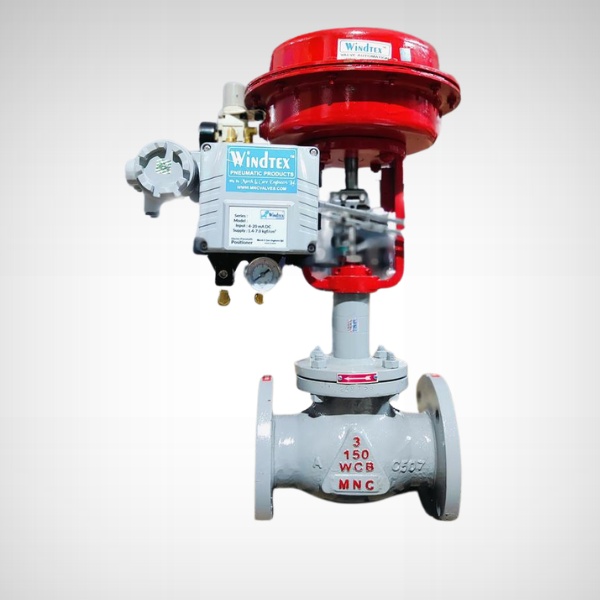
A two way control valve is a modulating valve with one inlet and one outlet used to regulate the flow of fluid through a single flow path. It is one of the most commonly used control valve types in industrial and utility systems where the process requires continuous adjustment rather than simple on-off isolation.
Two way control valves are widely used for flow control, temperature control, pressure regulation, and process balancing. They are commonly selected where the user needs stable and accurate control of water, steam, air, oil, or process fluids in automated systems.
The actuator receives a control signal and moves the valve plug, stem, disc, or closure element inside the valve body. This changes the effective flow area and regulates the amount of fluid passing through the valve.
Unlike an isolation valve, a two way control valve operates in intermediate positions for modulation. This allows the system to increase, reduce, or maintain flow according to process demand.
With one inlet and one outlet, the valve is ideal for standard flow control applications requiring direct regulation through a single line.
Two way valves are highly suitable for controlled modulation in stable process and utility applications.
Used in water, utility, HVAC, thermal, chemical, and industrial automation systems.
Uses compressed air for actuation and is widely selected where faster response and industrial process automation are important.
Uses electric actuation and is widely used where electrical automation, building systems, or utility control integration is preferred.
Typical Consideration
Two Way Control Valve
Single inlet and single outlet
Flow control / pressure control / temperature control
CI / DI / WCB / CF8 / CF8M / application-specific materials
Flanged / threaded / application-specific connection
Pneumatic / motorized / manual override option
Water / steam / oil / air / chemicals / utility fluids
Modulating / regulating / throttling
Pneumatic or electrical depending on actuator system
HVAC / water treatment / utility / process control / automation
Used in chilled water and hot water systems for temperature and flow regulation in building and industrial HVAC applications.
Used in process water and utility circuits where regulated flow is important for stable operation.
Used where controlled steam or thermal medium flow is required for process heating or temperature control.
Suitable for regulating process fluids where stable and repeatable control is essential.
Used in general utility systems where automated fluid regulation improves efficiency and control.
Integrated into control loops requiring remote and continuous modulation of process fluid flow.
Flow Path
Single inlet and single outlet
Three port arrangement
Main Function
Direct flow regulation
Mixing or diverting service
Best Use
Standard modulation applications
Thermal mixing and diverting systems
System Simplicity
Simpler for direct control loops
Used where multiple flow path logic is required
Typical Application
Water, steam, utility, process flow control
HVAC, heat exchangers, mixing/diverting circuits
Ideal for direct modulation in a single flow line
Integrates well with modern pneumatic and electrical control systems for automatic process regulation.
Applicable across water, thermal, utility, and general industrial process systems.
Contact MNC Valves Limited for technical guidance, product selection support, and quotation for your industrial requirement.=
Technical support for selection
Quotation support for project needs
Application-focused product guidance
Business-ready follow-up action
MNC Valve Limited Popular Products
Ball Valve
Butterfly Valve & Gate Valve
Strainers Valve
Non Return Valve
Control Valve
Other Valve
A two way control valve is used for regulating flow through a single inlet and single outlet path in automated or controlled systems.
Two way control valves regulate a single flow path, while three way control valves are used for mixing or diverting service with three ports.
They are commonly used in HVAC, water treatment, utility systems, thermal service, chemical plants, and industrial automation applications.
Yes, two way control valves are available with pneumatic actuation for fast and reliable industrial control duty.
Yes, motorized two way control valves are widely used where electrical actuation and remote automation are preferred.
Water, steam, oil, air, chemicals, and utility fluids can be controlled depending on valve design and material compatibility.
Correct sizing is important because oversizing or undersizing can reduce control stability, response quality, and process efficiency.
The main advantage is simple and accurate modulation through a single flow path, making it suitable for many direct control applications.
It depends on the application. Pneumatic actuation is preferred where faster industrial response is needed, while motorized actuation is preferred where electrical integration is more practical.
Because MNC Valves Limited provides technical selection support, application guidance, and industrial two way control valve solutions suitable for automation and process control duty.
WhatsApp us