
MNC Valves Ltd.
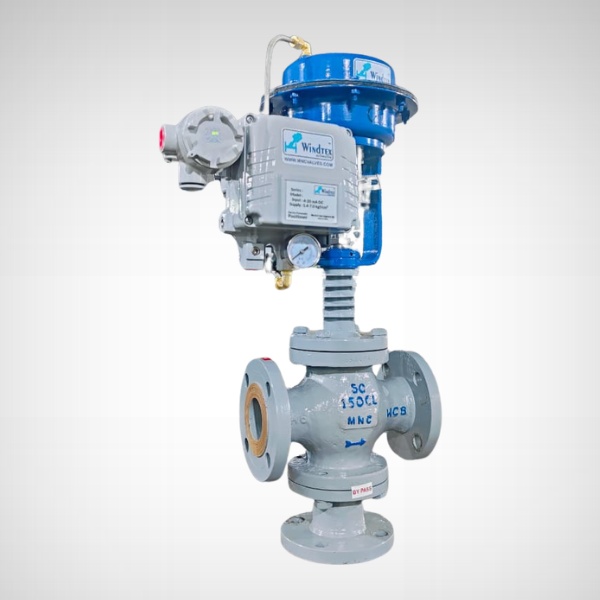
MNC Valves Limited offers three way control valves engineered for precise mixing and diverting applications in HVAC systems, heat exchangers, utility circuits, thermal control loops, process plants, and industrial automation systems where stable flow distribution is critical.
Designed for mixing and diverting control applications
Ideal for heat exchangers, HVAC, and thermal systems
Available in pneumatic and motorized actuation options
Improves temperature stability and process control accuracy
Without proper mixing control, many systems suffer unstable outlet temperature, poor thermal balance, and inefficient performance.
Standard two way valves cannot manage applications where one stream must be split or two streams must be mixed in a controlled way.
Poor flow distribution increases energy consumption, creates unstable operating conditions, and reduces process efficiency.
A three way control valve is a multi-port modulating valve used to control the direction or mixing of fluid flow. It is mainly used in two functional modes: mixing or diverting. Because of its three-port body design, the valve can regulate more complex flow logic than a standard two way control valve.
These valves are widely used in HVAC systems, heat exchangers, chilled water and hot water circuits, boiler temperature control, and process plants where temperature and flow balancing are critical.
Used when two inlet streams need to be combined into one controlled outlet stream. Common in heating and cooling loops where temperature blending is required.
Used when one inlet stream needs to be directed into one of two outlet paths in a controlled manner. Common in bypass and flow distribution applications.
The actuator applies force to the diaphragm assembly, moving it toward or away from the weir or control passage. This changes the flow area and regulates the process medium according to system demand.
By controlling the valve position continuously, the system can maintain stable outlet temperature, balanced flow distribution, and improved process efficiency in changing operating conditions.
Three way control valves help maintain more stable outlet temperature in heat exchanger, HVAC, and thermal mixing applications.
They simplify systems where fluid needs to be mixed or redirected without using multiple separate control devices.
With proper material and sizing selection, diaphragm control valves can provide stable control in specialty fluid applications.
Pneumatic actuation is preferred where compressed air is available and faster response or industrial process automation is required.
Motorized actuation is preferred where electrical automation, building management integration, or remote control systems are used.
Typical Consideration
Three Way Control Valve
Mixing / diverting / flow distribution / thermal balancing
Three port body arrangement
CI / DI / WCB / SS / application-specific materials
Flanged / threaded / application-specific design
Water / hot water / chilled water / steam / utility fluids / process liquids
Pneumatic / motorized / manual override option
Mixing / diverting / modulating control
Pneumatic or electrical depending on actuator and automation system
HVAC / heat exchanger / thermal systems / process automation
Used for chilled water and hot water mixing or diverting applications to maintain accurate building and process temperature control.
Used for controlling thermal media distribution and maintaining the required outlet temperature conditions.
Useful in thermal control loops where water or heating medium must be mixed or redirected to maintain stable performance.
Used in cooling circuits where flow needs to be distributed or blended for stable system operation.
Integrated into process loops where fluid routing and modulation are required for efficient automation performance.
Suitable in applications where multi-port control is required for better process and energy management.
Flow Logic
Single flow path control
Multi-direction mixing or diverting control
Main Function
Direct modulation
Mixing / diverting / flow distribution
Best Use
Standard control loops
Advanced thermal and multi-flow applications
Application Complexity
Simpler
More advanced and flexible
Typical Industries
General process, utility, water
HVAC, heat exchangers, thermal systems, advanced automation
Contact MNC Valves Limited for technical guidance, product selection support, and quotation for your industrial requirement.=
Technical support for selection
Quotation support for project needs
Application-focused product guidance
Business-ready follow-up action
MNC Valve Limited Popular Products
Ball Valve
Butterfly Valve & Gate Valve
Strainers Valve
Non Return Valve
Control Valve
Other Valve
A three way control valve is used for mixing or diverting fluid flow in applications where multi-port control is required.
Mixing type combines two inlet streams into one outlet, while diverting type directs one inlet stream between two outlet paths.
They are commonly used in HVAC systems, heat exchangers, boiler systems, chilled water loops, and thermal process applications.
Yes, pneumatic three way control valves are widely used where fast response and industrial automation are required.
Yes, motorized three way control valves are widely used where electrical actuation and remote automation are preferred.
Because it can perform mixing or diverting functions in a single valve body, which is essential in many thermal and multi-flow systems.
HVAC, utility, thermal systems, heat exchanger circuits, industrial automation, and process plants commonly use them.
Water, hot water, chilled water, steam, utility fluids, and selected process liquids can be used depending on valve design and material compatibility.
Correct sizing is important because control accuracy, mixing quality, diverting stability, and overall process efficiency depend on proper valve selection.
Because MNC Valves Limited provides technical selection support, actuation guidance, and industrial three way control valve solutions for mixing, diverting, and advanced process control applications.
WhatsApp us